


Reinforced cement concrete uses advantages and disadvantages are important to understand before planning any RCC house or building. Reinforced Cement Concrete, or RCC, is a composite material made by combining concrete and steel reinforcement. Concrete resists compression well, while steel bars help resist tension and bending forces. This makes RCC suitable for slabs, beams, columns, footings, staircases, lintels, and framed structures. This guide explains RCC meaning, components, uses, benefits, limitations, and key quality checks for safe construction.
The most widely used material in construction is concrete. It’s a mixer of cement, sand, aggregate, water and sometimes admixtures. It’s the most essential building material used in all types of construction projects, including homes, high-rise buildings, roads, dams, bridges, etc. Concrete can be moulded into a variety of shapes with the right formwork and is also available in many different types. But, reinforced cement concrete is the most popular type among all types of concrete.
Reinforced cement concrete (RCC) is an extensively used and adaptable building material that combines the flexibility and tensile strength of steel reinforcement with the strength of concrete. It has completely changed the way we construct buildings by providing a dependable and long-lasting solution for a variety of uses.
So, in this blog, Brick & Bolt provide a detailed guide on reinforced cement concrete, including what it is, types of reinforcement used in RCC, factors its uses, advantages and disadvantages, and the factors to consider before using RCC.
Quick Summary
Reinforced Cement Concrete is concrete strengthened with steel bars or mesh to resist both compression and tension. RCC is widely used in beams, slabs, columns, footings, roofs, staircases, bridges, and framed buildings. Its main advantages are strength, durability, fire resistance, and design flexibility, while disadvantages include higher cost, skilled labour needs, formwork, curing, and corrosion risk if poorly built.
What is Reinforced Cement Concrete -RCC?
Reinforced cement concrete is made by combining concrete and steel bars, or reinforcement bars, the importance of reinforced cement concrete is RCC simultaneously support the tensile and compressive strength of the structure. Plain concrete cement is very strong in compression but weak in tension and has a low resistance to tension. Steel, on the other hand, is equally strong in both compression and tension, which is why plain concrete can only be used where the structural component is in pure compression. Therefore, steel and concrete work incredibly well together and are used to absorb all stresses.
Types of Reinforcement Used in RCC:
The following types of reinforcement are used to make reinforced cement concrete
1. Mild Steel Bars
Mild steel bars are generally bent easily without breaking at the bends. They are available in different diameters, but you have to check if they meet the requirements of the applicable codes regarding characteristic strength in tension.
2. Hot Rolled Bars
Hot rolled bars are specially prepared reinforcements. Compared to mild steel bars, their tension strength is nearly twice as high and is commonly available in thick sections. They can be bent without developing any defects when heated to up to 100°C, but using regular mild steel bars is not achievable.
3. Cold-Worked Bars
The cold-worked steel bars are formed into twisted or stretched shapes with long ribs or other structures running the length of them. Additionally, their characteristic strength is significantly higher than mild steel bars’, at approximately 425 N/mm2 instead of 250 N/mm2. These bars might not be heated in order to bend and re-bend.
4. Steel Fabric
Steel fabrics are made with different types of bars and wires such as indented and deformed wires, plain round wires, and deformed steel bars of cold-worked bars etc. These wires are made into mesh by carefully and strictly welding straightened lengths together in compliance with the specifications. If proper care should be not taken, there could be a negative impact on the mechanical characteristics of the reinforcement.
Main Components of RCC
|
Component |
Function |
|
Cement |
Binds the concrete mix together |
|
Fine aggregate |
Fills voids and improves workability |
|
Coarse aggregate |
Provides bulk and compressive strength |
|
Water |
Starts cement hydration and helps mixing |
|
Steel reinforcement |
Resists tension, bending, and cracking |
|
Concrete cover |
Protects reinforcement from corrosion and fire |
|
Formwork |
Holds wet concrete in the required shape |
|
Curing |
Helps concrete gain strength and durability |
Uses of Reinforced Cement Concrete
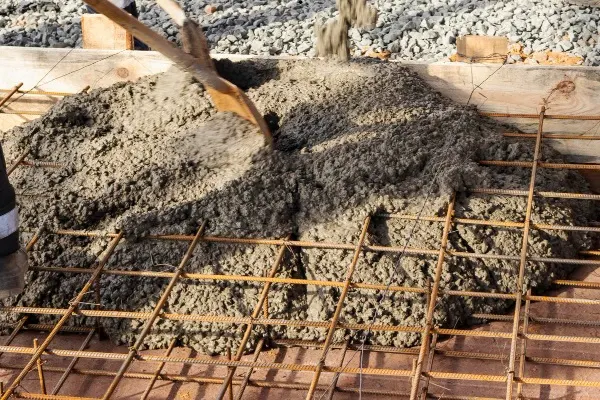
RCC is the most practical and affordable material for various building applications, such as:
- Buildings
- Bridges
- Roads
- Water Tanks
- Flyovers
- Floating Structures
- Foundations
- Marine Structures
- Precast Works
- Bunkers and Silos
- Chimneys and Towers
- Pipes and Conduits
- Retaining Walls
Reinforced Cement Concrete Uses Advantages and Disadvantages: Quick Overview
|
Aspect |
Key Points |
|
Main uses |
Beams, slabs, columns, footings, roofs, staircases, tanks |
|
Main advantages |
Strength, durability, fire resistance, design flexibility |
|
Main disadvantages |
Cost, skilled labour, formwork, curing, corrosion risk |
|
Best for |
Structural members in residential and commercial buildings |
|
Not ideal for |
Work without proper design, curing, supervision, or quality control |
|
Critical checks |
Steel placement, concrete grade, cover, compaction, curing |
Advantages of Reinforced Cement Concrete
The following are the advantages of reinforced cement concrete.
1. Strength
It is among the best building materials because of its excellent tension and compression strengths.
2. Durability
The RCC structures are long-lasting and durable. It can endure for up to 100 years and is not impacted by snow or rainfall. Because RCC has a low permeability, it can withstand substances like carbon dioxide, sulfates, and chlorides that dissolve in water without having significant deterioration.
3. Ductility
The reinforcement bar gives the ductility to the reinforced concrete structures. When reinforced concrete is overloaded, its ductility appears as distress in the form of cracks and deflection. This gives the engineers the opportunity to think of ways to prevent concrete damage to it.
4. Versatility
At the construction site, the concrete can be shaped into the desired shapes, forms, surfaces, textures, and sizes using shuttering or formwork configuration. When concrete is made, it is liquid, which makes it more suited for a variety of architectural needs.
5. Cost-Effective
The components of RCC are inexpensive and widely accessible worldwide. The cost of production is also extremely low. It is extensively utilized because reinforced concrete lasts a long time and requires less maintenance. In addition to being resilient and long-lasting, reinforced concrete uses less energy, resulting low operating costs of the structure.
6. Fire Resistance
No fire or burn occurs in the RCC. It can resist heat for a duration of two to six hours. Compared to other construction materials like steel and wood, reinforced concrete buildings have a higher fire resistance.
Disadvantages of Reinforced Cement Concrete
The following are the disadvantages of reinforced cement concrete:
- RCC structures are normally heavier than those made of steel, wood, or glass.
- Generally, RCC buildings require a lot of labour and site or workspace to fix because they require massive formwork, centring, and shuttering.
- It takes time for RCC to reach its maximum strength. Thus, it cannot be use right away after construction.
- Mixing, casting, and curing are the three primary steps to make reinforced concrete which all influence its ultimate strength.
- When compared to other methods, the forms needed for casting RCC are expensive.
- Strength loss and the formation of cracks are caused by shrinkage.
Important Quality Checks in RCC Work
|
Check |
Why It Is Important |
|
Concrete grade |
Ensures required strength |
|
Steel diameter and spacing |
Matches structural design |
|
Concrete cover |
Protects steel from corrosion and fire |
|
Bar lapping and anchorage |
Ensures force transfer through reinforcement |
|
Shuttering alignment |
Maintains member size and shape |
|
Compaction |
Prevents honeycombing and voids |
|
Curing |
Helps concrete gain strength |
|
Material quality |
Prevents weak or contaminated concrete |
|
Waterproofing in wet areas |
Reduces seepage and corrosion risk |
|
Site supervision |
Catches errors before concrete hardens |
IS 456 includes provisions for durability, cover, concrete production, and quality control, which are important for RCC performance.
Common Mistakes in RCC Construction
Avoid these mistakes during RCC work:
- Reducing steel bars to save cost
- Using excess water in concrete
- Ignoring concrete cover
- Placing reinforcement directly on shuttering
- Poor compaction during concrete pouring
- Removing formwork too early
- Skipping curing after concreting
- Cutting beams, slabs, or columns without approval
- Ignoring honeycombing or exposed reinforcement
- Using unapproved changes at site
These mistakes can lead to cracks, deflection, leakage, corrosion, and reduced structural life.
Practical Example: RCC in a House
In a typical RCC framed house, loads from the slab transfer to beams. Beams transfer the loads to columns. Columns transfer the loads to footings, and footings transfer them safely to the soil.
If one part of this load path is poorly built, the building may develop cracks or settlement problems. For example, weak column concrete, insufficient steel, or poor footing design can affect the entire structure. This is why RCC work should follow structural drawings from foundation to roof.
Where RCC Is Most Useful
RCC is especially useful where strength, shape flexibility, and long-term performance are needed.
|
Situation |
Why RCC Is Suitable |
|
Multi-storey homes |
Handles vertical and lateral loads |
|
Large rooms |
Beams and slabs can be designed for spans |
|
Parking areas |
Columns and beams create open space |
|
Staircases |
RCC gives strength and custom shape |
|
Balconies |
Can project safely when designed correctly |
|
Roof slabs |
Provides durable terrace or roof structure |
|
Water tanks |
Can resist water load with proper detailing |
|
Retaining walls |
Supports soil pressure with reinforcement |
For exposed, wet, coastal, or aggressive environments, concrete cover, mix quality, and waterproofing become more important.
Conclusion
Reinforced cement concrete uses advantages and disadvantages should be understood before choosing RCC for any building work. RCC is strong, durable, fire-resistant, and flexible, making it suitable for slabs, beams, columns, footings, staircases, and framed structures. Its limitations include higher cost, formwork needs, skilled labour, curing requirements, heavy self-weight, and corrosion risk if poorly executed. For safe construction, follow approved drawings, maintain concrete cover, use quality materials, compact properly, and cure concrete as specified.
FAQs
- What is reinforced cement concrete?
Reinforced Cement Concrete is concrete strengthened with steel reinforcement. The concrete resists compression, while steel bars resist tension and bending forces, making RCC suitable for structural members such as slabs, beams, columns, and footings. - What is the full form of RCC?
The full form of RCC is Reinforced Cement Concrete. It is called reinforced because steel bars or mesh are placed inside concrete to improve tensile and bending resistance. - What are the main uses of reinforced cement concrete?
The main uses of reinforced cement concrete include slabs, beams, columns, footings, staircases, lintels, retaining walls, water tanks, bridges, and RCC framed structures. It is widely used in residential, commercial, and infrastructure construction. - What are the advantages of RCC?
The main advantages of RCC are high strength, durability, fire resistance, shape flexibility, material availability, and suitability for many structural applications. It can be designed for different loads, spans, and building types. - What are the disadvantages of RCC?
The main disadvantages of RCC are higher cost, heavy self-weight, need for formwork, skilled labour, proper curing, and quality control. Steel reinforcement can also corrode if concrete cover and durability measures are poor. - What is the difference between RCC and PCC?
RCC contains steel reinforcement and is used for structural members. PCC does not contain reinforcement and is mainly used for levelling, base preparation, bedding, and non-structural concrete works. - Why is steel used in reinforced cement concrete?
Steel is used in RCC because concrete is weak in tension. Steel bars provide tensile strength and help the member resist bending, cracking, and load effects more effectively. - Is RCC suitable for house construction?
Yes, RCC is suitable for house construction when designed and executed correctly. It is commonly used for foundations, columns, beams, slabs, staircases, roofs, and framed structures in modern homes.