


Building Construction Equipment includes the machines, tools and mechanical systems used to perform excavation, lifting, mixing, transportation, compaction and other construction activities. The right equipment can help construction teams complete repetitive or physically demanding work more efficiently while improving consistency and site productivity.
Equipment needs vary according to project size, building type, site conditions and construction methods. A small residential project may require basic concrete and material-handling equipment, while a large commercial development may use excavators, cranes, loaders and specialized machinery. This guide explains the major categories of construction equipment, their uses, advantages and selection considerations.
Quick Answer
Building Construction Equipment refers to machinery and mechanical tools used for activities such as excavation, material handling, concrete production, lifting, compaction and finishing. Common examples include excavators, loaders, cranes, concrete mixers, vibrators, compactors and forklifts. Equipment should be selected according to the project’s scale, site conditions, required capacity, operating costs and safety requirements.
Category-wise building construction equipment

Hand Tools
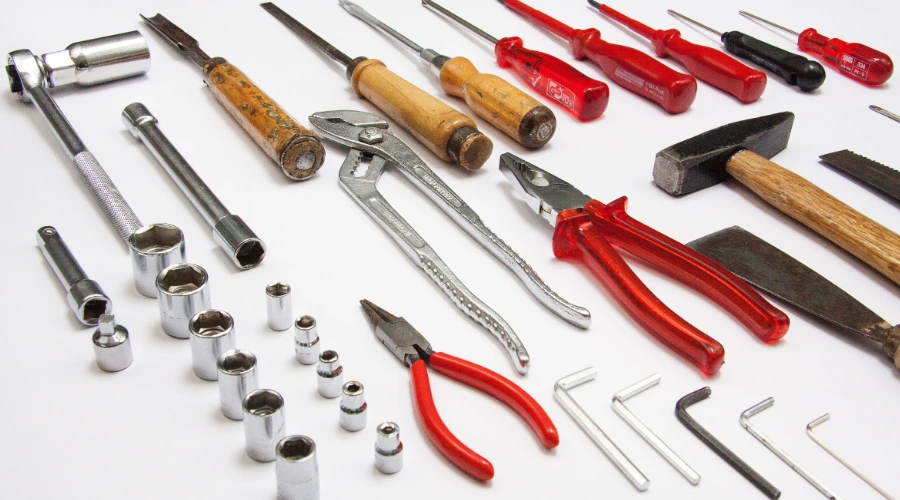
Hand tools are simple tools used for ordinary activities like measuring, cutting, shaping, etc. These tools offer precision in certain areas where power tools can’t. These tools are also portable and usually cost less than other equipment. Some common hand tools are listed below.
Hammers
A hammer is a tool with a weighted head fixed to a long handle. This tool is often used for small tasks like driving or removing nails from walls, crushing or shaping materials, etc.
Screwdrivers
As the name suggests, screwdrivers are simple tools that are used to tighten or remove screws from a surface. They come in different sizes that can be used according to the screw size.
Wrenches
A wrench is a tool used to grip, tighten, loosen, or turn things like nuts and bolts, pipes, etc. They come in different sizes and can be used for various purposes.
Hacksaws
A hand tool used to cut through metals like copper pipes and conduits. It’s a useful tool for electricians and plumbers.
Drills
A hand drill makes holes in several materials like wood, brick, concrete, etc. It can also help tighten or loosen screws and other fasteners.
Power Tools
These are electrically or pneumatically operated tools that increase the speed and accuracy of the work. These tools are a little more efficient than hand tools and help workers complete tasks quickly.
Circular saw
It is a power tool designed to cut through wood and other materials. It has a sharp circular blade that rotates extremely fast to cut through materials.
Jacking hammer
This tool is very efficient in breaking or making holes in large and hard materials like rocks, walls, pavements, etc.
Grinder
A grinder, or an angle grinder, is a power tool used to cut, grind, or smooth hard surfaces.
Heavy Equipment
Any kind of construction vehicle or other equipment that is employed in earthmoving, material handling, and lifting comes under the heavy equipment category.
Excavator
Excavators, also called diggers, are earthmoving equipment that is used for digging, demolition, landscaping, grading land, etc.
Bulldozer
A bulldozer is an earthmoving machine heavy machine used for shallow digging, ditching, leveling, demolishing, etc.
Crane
A crane is designed to lift and move loads. They do this in tall and large structures, such as tall buildings.
Loader
Multi-Terrain Loaders and Wheel Loaders can handle various materials across different terrains. They can navigate uneven ground, rough terrain, and soft soil.
Safety Gear
Construction work, no matter how small or big, requires proper safety precautions and measures. There are safety rules and regulations that all contractors and workers should follow while doing construction work.
This gear includes
- protective helmets,
- safety goggles,
- hand gloves,
- safety shoes,
- Full-face shields,
- N95 masks,
- Full-face respirators,
- Full-body protective suits, and many more.
Versatile and Adaptable Machines
Furthermore, it is said that the construction industry is meeting modern demands. It is doing so by using more machines, that include articulated dump trucks, wheel trenchers, and soil compactors. These machines are used in all kinds of places such as in field tractors and in planting on asphalt or soil. They are used in road construction and skyscraper construction too. They ensure that construction is continuous.
Drones and Robotics
- Drones are used in construction to survey sites and monitor worker safety. They are also useful for taking high-quality photos of finished buildings.
- In this way, we can get into areas that are difficult to access or even areas that are risky to go through with the workers.
- Machines controlled by computers are also more accurate, precise, and fast than humans. They also make fewer mistakes and face fewer accidents.
Road Rollers
- Road Rollers are used to ensure a solid and stable foundation for construction projects, for compacting soil and asphalt.
- These machines are specialized. They apply controlled pressure to the ground. This compacts the soil or asphalt to make a sturdy base for buildings, roads, and other infrastructure.
Mobile Cranes
- Mobile cranes are designed to lift and move loads. They do this in tall and large structures, such as tall buildings.
- Such strong machines can be moved from one site to another. This means they are used to provide the lifting capacity needed in construction.
Telescopic Booms and Boom Lifts
- Telescopic and Boom Lifts are focused and provide many benefits over using a crane for more accurate and maneuverable lifts.
- This equipment is quite important in places such as the interior part of buildings and other structures where workers may be
Cloud-based Solutions
- We fully automate our operations and business processes. This allows one to point out that by using mobile apps and cloud solutions. They can cut the main routine work. This work involves collecting and entering data and filling in reports and documents.
- This saves time and money. It also benefits the work’s precision and uniformity.
Key Functions of Construction Equipment
Contractors use construction equipment for various purposes. Some key functions of these instruments include:
- Site Preparation
- Material Handling
- Concrete Work
- Masonry
- Carpentry
- Surveying
- Safety
Conclusion
Building Construction Equipment helps teams perform excavation, lifting, concrete work, material handling, compaction and finishing more efficiently. The right machinery depends on the task, project scale, site conditions, capacity requirements and available resources. Excavators, cranes, loaders, concrete mixers, pumps, vibrators and compactors are among the commonly used machines, but equipment should never be selected simply because it is powerful or widely used. Proper planning, maintenance and trained operation are equally important for productivity and safe construction.
FAQs
- What is Building Construction Equipment?
Building Construction Equipment includes machines, mechanical tools and related systems used to perform construction activities such as excavation, lifting, concrete mixing, material handling, compaction and finishing. Equipment ranges from small portable machines to heavy machinery such as excavators and cranes. The appropriate equipment depends on the project’s work requirements, scale and site conditions.
- What are the main types of construction equipment?
The main categories include earthmoving equipment, material-handling equipment, concrete equipment, compaction equipment, drilling machinery, demolition equipment, finishing equipment and temporary power or utility equipment. Examples include excavators, loaders, cranes, forklifts, concrete mixers, pumps, vibrators, compactors, generators and drilling machines.
- What equipment is commonly used for concrete work?
Common concrete equipment includes concrete mixers, batching plants, concrete pumps, concrete vibrators and power trowels. Mixers and batching plants prepare concrete, pumps transport it to the placement location, vibrators consolidate fresh concrete and power trowels finish large floor surfaces. Equipment selection depends on concrete volume, access and project requirements.
- What is the most commonly used earthmoving equipment?
Excavators, backhoe loaders, bulldozers and wheel loaders are among the commonly used earthmoving machines. Excavators are useful for digging and trenching, backhoe loaders combine digging and loading functions, bulldozers push and grade materials, and wheel loaders move loose materials. The appropriate machine depends on the task and site conditions.
- Should construction equipment be purchased or rented?
The decision depends on how frequently and for how long the equipment will be needed. Renting can be practical for short-term or specialized work because it avoids long-term ownership and storage costs. Purchasing may make sense when equipment is required regularly. Fuel, maintenance, transport, operators and downtime should be included in the comparison.
- Why is construction equipment maintenance important?
Maintenance helps keep machinery reliable and reduces avoidable breakdowns during construction. It can include inspections, lubrication, fluid checks, servicing and repairs according to the manufacturer’s requirements. Well-maintained equipment can also operate more predictably and safely. Maintenance records should be kept for equipment requiring scheduled inspection or servicing.
- What safety precautions should be followed when using construction equipment?
Construction equipment should be operated by trained personnel and inspected before use. Operators should follow the manufacturer’s instructions, respect rated capacities and keep unauthorized people away from operating zones. For lifting equipment, the load, lifting radius, ground conditions and overhead hazards should be assessed. Required protective equipment and site procedures should also be followed.
- How do I choose the right construction equipment?
Start by identifying the exact task, required capacity and expected work volume. Then consider site access, ground conditions, project duration, machine availability, operating costs, maintenance and operator requirements. The equipment should be capable of completing the work safely without being unnecessarily large or inefficient for the site’s conditions.
 prasanthkumar