


A burnt clay brick is a clay brick fired at high temperature to improve strength, hardness, and durability. It is one of the most widely used masonry materials for walls, foundations, partitions, and general building work. These bricks are made by preparing clay, moulding it, drying it, and burning it in kilns. Their quality depends on proper firing, shape, size, colour, water absorption, strength, and efflorescence level. This guide explains burnt clay brick types, manufacturing process, properties, uses, advantages, disadvantages, and quality checks for construction.
Quick Summary
A burnt clay brick is a kiln-fired clay masonry unit used in brick masonry, walls, foundations, and structural or non-structural construction. It is valued for durability, strength, availability, sound absorption, and thermal insulation. Common types include first-class, second-class, third-class, and fourth-class bricks, based on firing quality, shape, strength, and water absorption.
How Burnt Clay Bricks are Manufactured?
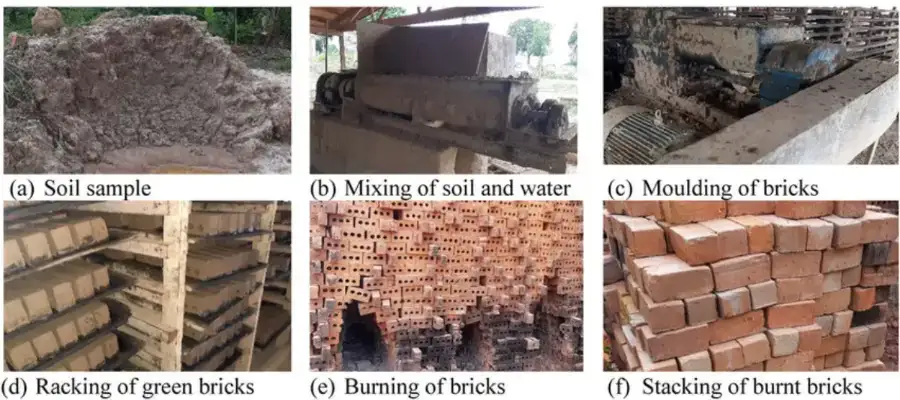
Image Source: Research gate
Preparation of Clay
The process of preparing clay involves six steps such as unsoiling, digging, cleaning, blending, weathering, and tampering.
- Unsoiling: The upper soil surface from which the clay needs to be excavated is removed up to a depth of 200 mm to eliminate impurities and other earthy particles.
- Digging: The clay is then mined manually or using mechanical equipment and heaped above the ground surface.
- Cleaning: The collected clay is cleaned to remove stones, pebbles, and other vegetable matter using a filtering screen.
- Blending: The filtered clay is mixed with sand and straw to improve the quality of the brick.
- Weathering: The blended clay mix is spread out on an open surface for direct exposure to the natural weather conditions for several weeks or even a month to allow plasticity and durable properties.
- Tampering: Adequate water is added to the weathered/seasoned clay, which is then kneaded with the help of labour or cattle two to three times and battered with shovels to make it a homogenous mix, ready for moulding.
Moulding
The prepared clay is transferred to a mould and compressed to eliminate gaps to acquire a good texture and finish, either manually or mechanically using high-powered compressing machines.
Drying
The moulded clay bricks are racked and kept under the sun for drying. Usually, the drying process takes around 3 to 10 days, depending on the climatic conditions.
Burning
After being exposed to the sun, the bricks are burnt in fire chambers (or kilns) at very high temperature (1100°C) for 10 to 40 hours to gain maximum strength and hardness.
Types of Burnt Clay Bricks
First-Class Bricks
The First Class Brick or Class-I brick is burnt at the right temperature and the shapes are perfect. It has a load-bearing capacity of more than 10.5 N/mm² and emits a clear ringing sound when struck. These bricks do not absorb water more than 20% and the efflorescence should be minimal. These bricks are used for load-bearing structures and walls that are exposed to extremely hot temperatures.
Second Class Bricks
The second-class bricks are slightly over-burnt. It has an uneven surface and possesses a slightly distorted rectangular shape. It has a load-bearing capacity of over 7 N/mm² and emits a ringing sound when struck.
They will not absorb water more than 22% of the actual weight. These bricks can be used for load-bearing walls, but cannot be used for exposed walls.
Third Class Bricks
The third-class bricks are either overburnt or underburnt. They have an irregular surface and shape with a load-bearing capacity of over 3.5 N/mm². These bricks produce a dull sound when struck. It is used in non-structural parts of construction, such as gardening walls and landscaping.
Fourth Class Bricks
Fourth-class bricks are kiln-rejected bricks, which are either overburnt or underburnt. The overburnt bricks are dark coloured, hard, and highly irregular in shape. These bricks are used as an aggregate for concrete and as a road metal. The underburnt bricks are yellow with low strength and can be powdered easily.
Properties of Burnt Clay Bricks
Shape & Size
An ideal brick should have a uniform shape and size with sharp edges and perfect parallel sides. They should be of Indian Standard size of 19 x 9 x 9 cm.
Colour
A perfect burnt clay brick should be bright red and uniform in colour.
Texture & Compactness
The burnt fire brick should be of fine, dense, and uniform in texture. The bricks should not possess any cavities, loose grit, unburnt lime, or high efflorescence.
Hardness
An ideal brick should be hard enough to withstand wear and tear. When scratched with hard substances, it should not cause any impressions on the brick’s surface.
Load-bearing test
This test is conducted to determine the load-bearing capacity of the brick. An ideal brick should have high strength (not less than 10 N/mm²). The blocks with higher strength have the capacity to withstand heavy loads.
Water Absorption
The brick is soaked in water for 24 hours and weighed, if the total weight gained is less than 20%, it is suitable for use.
Efflorescence
The brick should not form white patches on the surface when immersed in water or exposed to rain and humid conditions. The bricks with low efflorescence have high durability to withstand wet conditions.
Applications of Burnt Clay Bricks
Burnt clay brick is used in many construction areas because it is strong, available, familiar to masons, and suitable for different wall types.
Common applications include:
- Residential masonry walls
- Load-bearing walls
- Partition walls
- Foundations and plinth work
- Boundary and compound walls
- Chimneys and fireplaces
- Retaining walls
- Decorative exposed brickwork
- Schools, hospitals, theatres, and public buildings
- Road metal or aggregate using rejected overburnt bricks
Brick & Bolt also notes that burnt clay bricks are used for walls, foundations, structural and decorative elements, chimneys, high-temperature areas, sound-sensitive buildings, and retaining walls.
Advantages of Burnt Clay Brick
Burnt clay brick remains popular because it offers practical benefits for everyday construction.
Good Strength and Durability
A properly burnt clay brick can perform well in masonry walls and general building work. First-class bricks are especially suitable where strength and durability are important.
Weather Resistance
Well-burnt bricks can resist normal weather exposure when used with proper mortar, plaster, coping, and damp protection.
Easy Availability
Burnt clay bricks are widely available in many regions, making them familiar to contractors and masons.
Thermal Comfort
Clay bricks can support better thermal comfort than many lightweight materials because they have good thermal mass. Brick & Bolt also identifies burnt clay bricks as natural thermal insulators.
Sound Absorption
Dense clay brick walls can reduce sound transmission better than many thin wall systems. This makes them useful in homes, schools, hospitals, and theatres.
Versatile Use
Burnt clay bricks can be used in load-bearing walls, framed structures, partitions, boundary walls, and decorative masonry when the right class is selected.
Disadvantages of Burnt Clay Brick
Burnt clay brick also has limitations that should be considered.
Environmental Impact
Traditional brick burning can cause air pollution because kilns emit smoke and consume fuel. Brick & Bolt lists air pollution, soil and water loss, and waste generation as key disadvantages of burnt clay brick manufacturing.
Heavy Weight
Burnt clay bricks are heavier than some modern blocks. This can increase dead load, handling effort, and labour time.
Variation in Quality
Brick quality can vary from kiln to kiln. Poorly burnt, cracked, or irregular bricks may reduce masonry quality.
Water Absorption
Some clay bricks absorb water if not properly burnt. This can affect plaster, dampness, and durability if moisture protection is poor.
More Mortar Joints
Small brick size means more joints compared with larger blocks. This can increase mortar consumption and labour time.
How to Check Burnt Clay Brick Quality on Site
Before using burnt clay bricks, check a sample from each batch.
A good brick should have sharp edges, uniform colour, and regular shape. When two bricks are struck together, they should produce a clear ringing sound. A dull sound may indicate cracks or poor burning.
Check hardness by scratching the surface with a hard object. A good brick should not show deep marks easily.
For water absorption, weigh a dry brick, soak it in water for 24 hours, and weigh it again. The weight gain should generally be within acceptable limits for the class of brick.
Also check for efflorescence. If white salt patches appear heavily after wetting and drying, avoid using those bricks in exposed or damp areas.
Common Mistakes to Avoid
Do not use third-class or fourth-class bricks for structural masonry. They may not provide enough strength or durability.
Do not accept bricks only because they are cheaper. Poor bricks can increase plaster thickness, mortar use, breakage, and repair cost.
Do not ignore water absorption. Highly absorbent bricks can lead to damp patches and weak bonding if not handled correctly.
Do not use bricks with cracks, lime nodules, broken edges, or excessive warping for visible or important walls.
Do not stack bricks directly in waterlogged areas. Store them on a dry, level surface and protect them from contamination before use.
Conclusion
Burnt clay brick is a durable and widely used masonry material made by moulding, drying, and kiln-burning clay at high temperature. It is suitable for walls, foundations, partitions, chimneys, boundary walls, and decorative brickwork when the right class is selected. First-class bricks are preferred for strong and exposed masonry, while lower-class bricks should be limited to non-critical work. Before purchase, check shape, size, colour, hardness, sound, water absorption, strength, and efflorescence. Good brick selection improves wall quality, durability, and long-term construction performance.
FAQs
- What is a burnt clay brick?
A burnt clay brick is a clay brick that is dried and fired in a kiln at high temperature to improve strength, hardness, and durability. It is commonly used for walls, foundations, partitions, chimneys, and general masonry construction. - What are the types of burnt clay bricks?
The main types are first-class, second-class, third-class, and fourth-class bricks. First-class bricks are the best quality and suitable for strong masonry. Second-class bricks are used where plastering is planned. Third- and fourth-class bricks are used only for low-importance or non-structural work. - What is the standard size of burnt clay brick in India?
The standard modular brick size commonly referred to in India is 19 × 9 × 9 cm. Mortar thickness may increase the nominal size in masonry. Brick size should be checked before construction because local brick sizes can vary. - Where are burnt clay bricks used?
Burnt clay bricks are used in load-bearing walls, partition walls, foundations, boundary walls, chimneys, fireplaces, decorative masonry, retaining walls, and general building construction. Their use depends on the brick class, strength, and exposure condition. - What are the advantages of burnt clay brick?
The main advantages are strength, durability, weather resistance, easy availability, sound absorption, thermal comfort, and suitability for many types of construction. First-class burnt clay bricks are especially useful where better strength and finish are required. - What are the disadvantages of burnt clay bricks?
The disadvantages include air pollution during manufacturing, heavy weight, soil consumption, quality variation, water absorption, and waste generation. Poorly burnt bricks may also crack, absorb too much water, or show excessive efflorescence. - How do you test burnt clay brick quality?
Check shape, size, colour, hardness, ringing sound, water absorption, and efflorescence. A good brick should be uniform, hard, compact, and produce a clear sound when struck. It should not absorb excessive water or show heavy white salt patches. - Can burnt clay brick be used for load-bearing walls?
Yes, burnt clay brick can be used for load-bearing walls when the brick class, strength, mortar, wall thickness, and structural design are suitable. First-class bricks are generally preferred for load-bearing masonry because they offer better strength and durability.
 prasanthkumar
  wordpress-prod
 )