


A concentrated load is a force applied over a very small area of a structural member, often treated as acting at a single point. It can come from a column resting on a beam, a generator placed on a roof slab, a rack leg on a floor, or a bracket fixed to a wall. Because the force is localised, it can create high stress, bending, shear, and deflection at one location. This guide explains concentrated load meaning, types, examples, effects, design checks, comparison with distributed loads, and common mistakes in construction. Brick & Bolt also identifies it as a point load that acts over a small region of a structure.
Quick Answer
A concentrated load, also called a point load, is a force applied to a small area or specific point of a structure. It creates local stress and must be considered carefully in beam, slab, column, and foundation design. Common examples include column loads on beams, equipment loads on slabs, rack legs, brackets, and cantilever supports.
This blog will explain what they are, how they work, and why they matter so that you can make wiser and safer construction decisions.
Property Tax Calculator: To estimate the annual tax on your property based on its location and size, try our easy-to-use Property Tax Calculator.
What is a Concentrated Load?
A point load, also known as a concentrated load, is a concentrated force that acts over a small region of a structure. It behaves like it’s coming from a point, but it is originating from a path carrying some amount. E.g., the column load acting on the beam, or a generator on the roof slab, are all considered as concentrated loads.
This kind of load induces stress into a small portion of a structural member and is very important in the design of beams, slabs, or even foundations. In contrast to uniformly distributed loads, concentrated loads may impart higher bending moments and forces at particular locations of a structure.
Construction Company Chennai: Planning a project in Tamil Nadu? Explore how our Construction Company in Chennai ensures quality and precision at every structural stage.
Types of Concentrated Loads
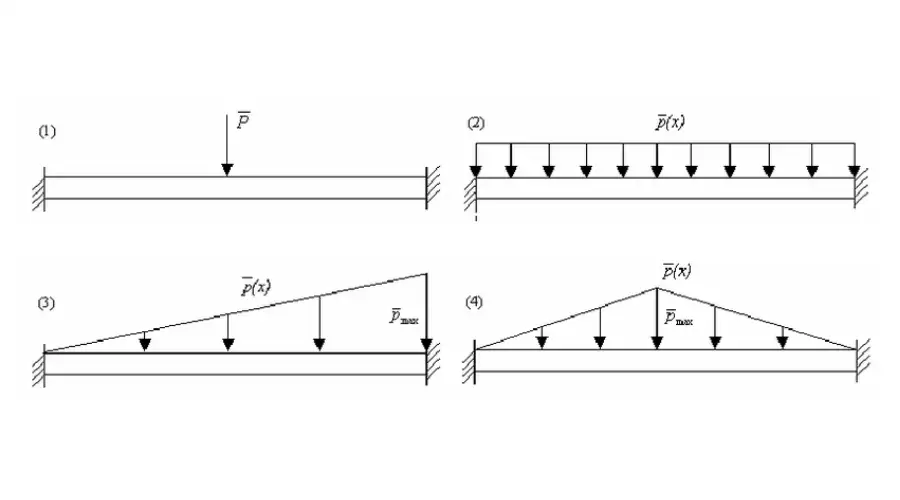
Concentrated loads, often referred to as point loads, are forces applied to a specific area or point of a structure. These loads are categorized based on their direction and application,
1. Vertical Concentrated Loads
These loads act downwards, such as the weight of a column on a beam or a person standing on a floor. They are the most common type and are critical in load-bearing design.
2. Inclined Concentrated Loads
These loads act at an angle, applying both vertical and horizontal forces. They are often seen in slanted beams or structures subjected to diagonal forces.
3. Horizontal Concentrated Loads
These forces are applied horizontally, such as wind pressure on a wall or the pulling force from a cable, affecting the lateral stability of the structure.
4. Eccentric Concentrated Loads
Applied off-center, these loads cause both a force and a moment, leading to bending in addition to direct loading.
5. Single Node and Element Loads
These loads are applied at a specific node or to a particular element, often including moments, to simplify structural analysis and calculations.
Each type requires precise consideration in structural load for safety and performance.
Compound Wall Cost Calculator: Understand how concentrated loads affect boundary structures by checking real-time expenses with our Compound Wall Cost Calculator.
Typical Locations of Point Load Application in Structural Systems
Concentrated loads show up in many places on a job site,
- Beams under columns: Where the vertical loads from the upper floors pass down and become a point force on the supporting beams through the columns.
- Supporting equipment pads on slab: Rooftop equipment such as generators, tanks, or solar inverters impart concentrated or patch loads through their anchoring points onto slabs.
- Brackets and cantilevers: Wall-mounted balconies, signage, or projections impose eccentric point loads via small brackets, threaded rods, or cantilevered members.
- Racking systems: The narrow legs of pallet racks or shelving units concentrate heavy vertical loads on small slab areas.
At Brick & Bolt, we routinely consider these factors during the design phase, ensuring each concentrated load is safely accounted for in structural plans.
Home Construction in Pune: Learn how local conditions and load management come into play during Home Construction in Pune for long-lasting, durable homes.
Impact of Point Load on the Structure
- Stress Concentration: The occurrence of point loads at a certain location causes stress concentration, i.e., shear stress and bending moments.
- Deflection: The transcendent point loads result in deflection in the beam, causing it to lose its rigid shape.
- Structural Integrity: If point loads appear very often or are too high, they can lead to metal fatigue and, finally, deformation of the structure.
- Foundation Settlement: The application of large point loads dispensed in the foundation of a building will cause the foundation to subside unevenly, hence producing cracks or tilting in the structure.
For better management of these undesirable impacts and ensuring the soundness of the structure, the design and the reinforcement must be secured accordingly.
Factors to Consider While Designing for Concentrated Loads
When dealing with concentrated loads, engineers must consider,
- Load Duration: Loads can be live or dead load. Short-term loads may be accepted with a reduced factor of safety; however, long-term or permanent point loads require more conservative design criteria to avoid fatigue and creep
- Material Strength and Behavior: Different materials—like concrete, steel, and timber—have different properties when it comes to resisting bending, shear, and compression. For example, reinforced cement concrete may resist vertical loads better than plain masonry but may still crack under a sharp, localized point load if not properly reinforced.
- Support Conditions: Whether the structural element is simply supported, fixed, or continuous changes how the load is distributed. A live load on a cantilever will produce very different stress and moment distributions than one on a simply supported beam.
- Load Position: A load at the center of a span produces the maximum bending moment, while one near the support creates more shear. Proper positioning of reinforcements and load paths is essential.
- Redundancy and Structural Integrity: Good designs include fallback systems. For instance, adding secondary beams or hidden reinforcements ensures the structure holds even if a primary load-bearing point weakens.
- Load Combinations: Point loads don’t act alone. They are usually added with UDLs, wind loads, earthquake forces, thermal loads, etc. The combination of these forces, as per IS 875 and IS 456, is designed to prevent any failure in your framed structure.
- Area of Contact: The stress concentration increases as the area of contact decreases. Such a concentrated load can be spread over more ground by using spread footings or the like in a load spreading plate
- Deflection Control: Noticeable deflection under point loads may be induced in slender beams or slabs. Over-deflection affects not only appearance, but also function and safety.
These are carefully examined in Brick&Bolt’s project evaluations to ensure they are code-abiding and long-lasting.
Cost Estimator: Get a detailed, load-based construction cost breakdown with our Cost Estimator to plan your project more effectively.
Concentrated Loads vs. Distributed Loads
| Feature | Concentrated Load | Distributed Load |
| Area of application | Single point | Spread over length or area |
| Effect on the beam | High local stress | Even stress distribution |
| Calculation complexity | High | Moderate |
| Design risk | Sudden failure if miscalculated | Gradual deflection |
| Example | Column on a beam | Floor slab weight |
| Load application method | Typically, through base plates or fixtures | Via uniformly layered materials |
| Structural design focus | Reinforcement at a specific point | General section sizing |
| Inspection priority | Check for stress concentration, cracking | Check for deflection and span behavior |
| Repair type | Local strengthening or jacketing | Surface treatments or slab thickening |
Conclusion
A concentrated load is a force applied over a small area, but its effect on a structure can be significant. It can create high local stress, bending moment, shear force, deflection, and even foundation settlement if not designed properly. Common examples include column loads, equipment bases, rack legs, brackets, cantilevers, and rooftop machinery. The safest approach is to identify point loads early, check their magnitude and position, provide proper reinforcement or load spreading, and verify the load path down to the foundation. For homes and buildings, any heavy permanent load should be reviewed by a qualified structural engineer before installation.
FAQs
- What is a concentrated load?
A concentrated load is a force applied over a small area of a structure and is often treated as acting at a single point. Brick & Bolt also describes it as a point load acting over a small region, such as a column load on a beam. - What is an example of a concentrated load?
A column resting on a beam is a common example of a concentrated load. Other examples include generators on roof slabs, rack legs on floors, brackets fixed to walls, machinery bases, water tank supports, and cantilever attachments. - What are the types of concentrated loads?
The main types include vertical concentrated loads, horizontal concentrated loads, inclined concentrated loads, eccentric concentrated loads, and single node or element loads used in structural modelling. Brick & Bolt lists these categories based on direction and application. - How does a concentrated load affect a beam?
A concentrated load can create high bending moment, shear force, and deflection in a beam. If the load is at mid-span, bending may become critical. If it is near a support, shear demand may become more important. - What is the difference between concentrated load and distributed load?
A concentrated load acts over a small point or contact area, while a distributed load spreads over a length or surface. Brick & Bolt explains that concentrated loads create high local stress, while distributed loads create more even stress distribution. - Why is load position important for concentrated loads?
Load position is important because it changes bending, shear, and deflection. Brick & Bolt notes that a load at the centre of a span creates maximum bending moment, while a load near support creates more shear. - Can concentrated loads cause foundation settlement?
Yes, large concentrated loads can cause uneven foundation settlement if soil pressure is not distributed properly. Brick & Bolt notes that heavy point loads transferred to foundations may cause cracks or tilting when not designed correctly. - How can concentrated loads be managed safely?
Concentrated loads can be managed through proper structural analysis, reinforcement detailing, larger contact areas, base plates, secondary beams, stiffeners, spread footings, and engineer-approved load placement. Heavy equipment or storage should not be placed on slabs without structural verification.
 prasanthkumar
  wordpress-prod