


A concrete brick is a precast masonry unit made mainly from cement, sand, water, and fine aggregates. It is used in wall construction because it offers uniform shape, good strength, easy availability, and flexible design options. Concrete bricks are commonly used in residential, commercial, boundary, partition, and non-load-bearing applications, depending on their type and grade. This blog explains what concrete bricks are, their main types, properties, manufacturing process, advantages, disadvantages, and how they compare with clay bricks so homeowners and builders can make better material decisions.
Quick Summary
A concrete brick is a factory-made construction brick produced from cement, sand, aggregates, and water. It is available in solid, hollow, fly ash, and interlocking forms. Concrete bricks are preferred for uniform size, durability, strength, and faster wall construction, but their performance depends on curing, quality control, water absorption, and correct use.
What is a Concrete Brick?
A concrete brick is a pre-casted cement brick made with a mixture of cement, sand, and fine aggregates. These laboratory-made bricks are produced under constant supervision to enhance their unique properties to stand out from other brick properties in the market.
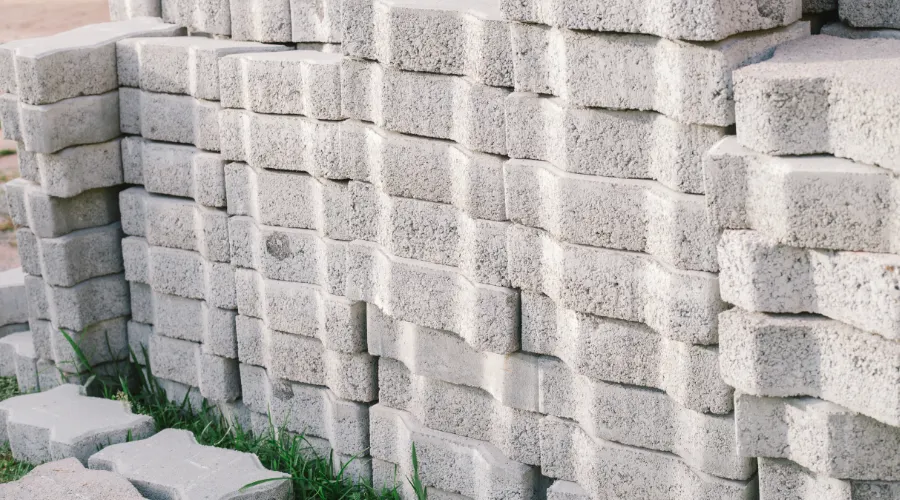
Types of Concrete Brick
Concrete bricks are generally classified into four types based on their weight, shape, and the aggregates used. The following are the types of concrete bricks:
- Solid Cement bricks
- Hollow Cement bricks
- Fly Ash Bricks
- Interlocking Bricks
Solid Cement Bricks
These bricks are dense, heavy, and uniform in structure, and they have high durability and strength. Solid Cement Bricks are used for the construction of foundation walls, columns, and other load-bearing structures.
Hollow Cement Bricks
Hollow cement bricks are lightweight and are designed with voids in the middle to reduce the overall weight. These bricks improve thermal insulation and have numerous advantages in terms of cost and production. They are generally used for the construction of non-load-bearing structures, such as partition walls and infilling panels, considering their lightweight nature.
Fly Ash Bricks
These are made from a mixture of cement and fly ash(extracts of coal). They are sustainable and eco-friendly bricks, using fly ash as the main aggregate. Fly ash bricks are lightweight, can withstand high temperatures and are even resistant to fire.
These bricks are commonly used in both residential and commercial projects. For example, these bricks are used as partition walls and in other non-load-bearing structures.
Interlocking Bricks
Interlocking bricks are a special type of brick that comes in different shapes and sizes. These bricks are designed to interlock bricks together, reducing the need of mortar and other adhesive pastes. These bricks are custom-made bricks that are manufactured based on the needs and requirements of the building.
Properties of Concrete Brick
Key Properties of Concrete Bricks
A concrete brick should be judged by performance, not only by price. Important properties include strength, size accuracy, water absorption, density, durability, and surface finish.
Strength
Concrete bricks can offer good compressive strength when properly manufactured and cured. Strength depends on cement content, aggregate grading, compaction, curing period, and quality control. For structural use, bricks should match the engineer’s specification.
Density and weight
Density affects handling, wall load, insulation, and structural design. Solid concrete bricks are usually heavier, while hollow bricks reduce dead load. A lighter unit may be easier to handle, but it must still meet strength and durability requirements.
Water absorption
Water absorption affects dampness, plaster bonding, efflorescence, and long-term wall performance. High water absorption can lead to moisture issues if the wall is not protected through proper plastering, waterproofing, coping, and drainage.
Dimensional accuracy
Uniform size makes brick masonry easier and reduces uneven mortar joints. This improves finish quality and can reduce plaster thickness in some cases.
Fire and weather resistance
Concrete bricks can provide good resistance to weather and fire exposure when made and used correctly. However, no brick should be selected only on a general claim. The specific product quality and wall design matter.
Raw Materials Required for Manufacturing
The raw materials required for the manufacturing of concrete bricks include Portland Cement, Water, Sand, and Gravel. In certain cases, fly ash and other additives are included as fine aggregates. Since concrete bricks are produced in various shapes and sizes, their colour pigments and additives may vary.
Manufacturing Process of Concrete Bricks
Preparation of Raw Materials
The raw materials such as cement, sand, aggregates, and additional fillers are chosen based on quality. The selected materials are tested in the laboratory for required standards and adequate proportions of the ingredients are determined.
Mixing and Blending
The cement, sand, and aggregates are mixed using mechanical mixers, adding water until they achieve a uniform and homogeneous mixture. An adequate proportion of additives (fly ash or other pigments) is blended to achieve the desired properties.
Molding
The cement mortar is poured into the molds of required shapes and sizes. Vibrators are used to eliminate pore gaps, and ahydraulic press compresses the mixture into a molded brick. The mortar is maintained in the mold throughout the drying and curing process for days until the bricks are completely solidified.
Curing & Drying
After molding, the concrete bricks are cured using water, air, or stream in a controlled environment to improve hydration and strength. The cured bricks are then removed from the molds and dried to remove excessive moisture content.
Quality Checks
Inspections are conducted throughout the manufacturing process from start to finish. Many quality checks are performed in the laboratory at different stages to check the quality of the bricks.
Pros & Cons of Using Concrete Bricks
Pros
- Highly durable and can withstand harsh weather conditions.
- Used in nearly every construction process.
- Available in various sizes, shapes, and designs.
- High thermal resistance and fireproof.
- Easily available and cost-effective.
Cons
- Solid blocks are heavy and require careful handling.
- Higher water absorption rate, causing efflorescence and moisture damage.
- Adds more loads to structures and could get cracked under excessive loads.
- Consumption of natural resources and high energy usage in manufacturing.
- Requires periodic maintenance for longevity.
Comparison between Concrete Bricks & Clay Bricks
| Aspect | Concrete Bricks | Clay Bricks |
| Raw materials used | Cement, Sand, Aggregate (limestone), and additives. | Surface clays, shales, sand, and fire clays. |
| Initial reaction | Shrinks due to loss of moisture | Expands due to the addition of moisture |
| Weight | Solid cement blocks weigh more than clay bricks. | Clay bricks are less weight compared to cement bricks. |
| Strength | Gains strength over time. | Loses strength over time. |
| Compressive strength | High compressive strength | Comparatively low compressive strength |
Conclusion
Concrete brick is a practical and versatile building material used in modern wall construction. It offers strength, uniform shape, design flexibility, and several product options, including solid, hollow, fly ash, and interlocking bricks. However, its performance depends on proper manufacturing, curing, storage, and correct application. The best choice should match the wall type, structural requirement, moisture exposure, and project budget. For important construction work, always confirm specifications with an engineer, architect, or qualified construction professional before purchasing materials.
FAQs
- What is a concrete brick?
A concrete brick is a precast masonry unit made from cement, sand, aggregates, and water. It is moulded into shape and cured to gain strength. Concrete bricks are used for walls, partitions, boundary walls, and other construction applications depending on their type and quality. - What are the main types of concrete bricks?
The main types of concrete bricks include solid concrete bricks, hollow concrete bricks, fly ash bricks, and interlocking bricks. Each type has a different use. Solid bricks are denser, hollow bricks reduce weight, fly ash bricks use fly ash, and interlocking bricks support faster aligned construction. - Are concrete bricks stronger than clay bricks?
Concrete bricks can be stronger than clay bricks in many applications, but strength depends on manufacturing quality, curing, mix design, and project specifications. Clay bricks also perform well when properly made and used. Structural use should always follow engineering recommendations. - Where are concrete bricks used?
Concrete bricks are used in residential walls, partition walls, boundary walls, compound walls, garden walls, infill panels, and selected load-bearing walls. The exact use depends on whether the brick is solid, hollow, interlocking, or designed for a specific construction purpose. - What are the benefits of concrete brick?
The benefits of concrete brick include uniform size, good durability, design flexibility, availability in different shapes, and suitability for many walling applications. It can also support faster masonry work when the bricks are consistent and the workmanship is good. - What are the disadvantages of concrete bricks?
Concrete bricks can be heavy, may absorb water if poorly made, and can develop cracks when quality or curing is weak. They also depend on cement, which has an environmental impact. Proper supplier selection and site handling reduce these problems. - Is concrete brick good for house construction?
Yes, concrete brick can be good for house construction when the correct type is selected. Hollow units may suit partitions, while solid units may suit stronger walls if approved by design. Quality, curing, wall location, and moisture protection are important. - How do I check concrete brick quality before buying?
Check concrete brick quality by looking for uniform size, sharp edges, consistent colour, no cracks, and proper curing. Ask for strength and water absorption details from the supplier. For major projects, use test reports or laboratory testing before bulk purchase.
 prasanthkumar
  wordpress-prod