


M15 grade concrete is one of the commonly used concrete grades for general construction applications, especially where moderate strength is required. It is made by combining cement, sand, and aggregates in a suitable proportion to achieve the required performance after curing. Understanding the M15 concrete mix ratio, strength, uses, and preparation method helps builders, homeowners, and construction professionals select the right material for different projects. This guide explains the properties, applications, advantages, and limitations of M15 grade concrete.
Quick Answer
M15 grade concrete is a concrete mix with a characteristic compressive strength of 15 MPa after 28 days of curing. It is commonly used for non-structural works such as flooring, leveling courses, and foundation preparation. The nominal mix ratio of M15 concrete is generally 1:2:4 (cement:sand:aggregate).
The M15 Concrete Mix Ratio Explained
The standard mix ratio for M15 concrete is 1:2:4. This means:
- 1 part of cement
- 2 parts of sand (fine aggregate)
- 4 parts of aggregate (coarse aggregate)
This ratio ensures the right balance between the strength, durability, and workability of the concrete.
What is M15 Grade Concrete?
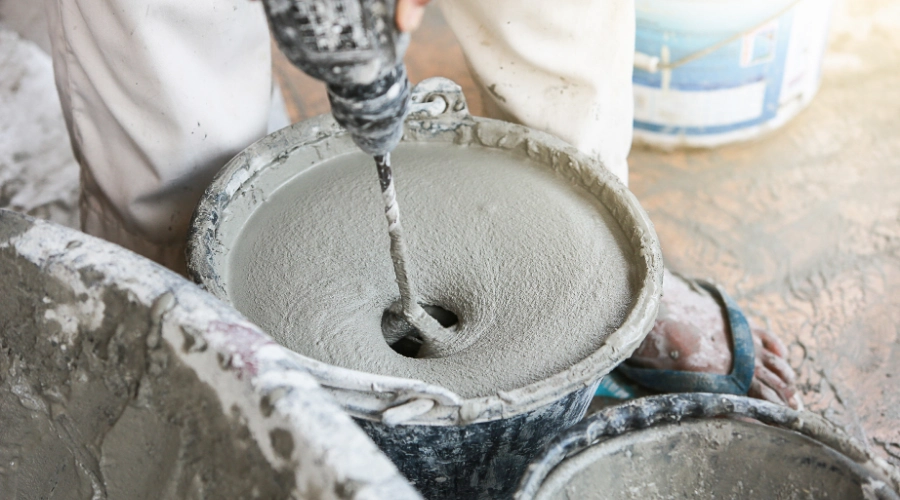
The M15 concrete has a compressive strength of 15 N/mm² (Newton per square millimetre). This is achieved after 28 days of curing. Its standard mix ratio is 1:2:4, which means 1 part cement, 2 parts sand, and 4 parts aggregate.
An M15 concrete is a nominal mix concrete. A nominal concrete mix has a fixed ratio that gives an approximate estimate of the materials required to make the concrete.
Key Components of M15 Concrete
An M15 concrete is made of cement, sand, and aggregate. They are mixed in specific ratios and hydrated with water to create the perfect M15-grade concrete mix.
- Cement: Cement acts as a binding agent responsible for holding all the components together. It gives the concrete strength.
- Sand: Sand includes fine aggregate particles that fill the void in the concrete mix. They create a dense concrete mix and improve workability.
- Aggregate: Coarse aggregate includes large particles like gravel or stone chips. They provide stability and strength to the concrete.
- Water: Water hydrates the components and starts the chemical reaction that stimulates hardening.
Compressive Strength of M15 Concrete
The compressive strength of an M15 concrete is fixed. However, if the construction project requires a lower or higher compressive strength, it might affect the material proportions.
Factors Affecting M15 Concrete Ratio
As discussed above, though M15 is a nominal concrete mix with a predetermined mix ratio of 1:2:4, it is just an estimation. The actual amount of each material required may vary depending on several factors, like the ones below.
Key Properties and Features of M15 Grade
The specific properties and quality of each material can affect the M15 mix ratio.
- The type of cement used can affect the water-cement ratio. This can alter the overall mix proportions.
- The fineness and moisture content of the sand can impact the water-cement ratio.
- The type and size of the aggregate can influence the volume of voids and impact material proportions.
Exposure Conditions
The weather conditions under which the concrete mix is exposed can influence the mix ratios.
Admixtures
Admixtures include water reducers, Concrete plasticizers, etc. They can affect concrete properties and material proportions.
Workability
Workability is the concrete’s ability to be mixed, placed, and compacted into shape. This can influence the amount of water and admixtures used and affect the overall mix proportions.
Where is M15 Concrete Used?
M15 concrete is a concrete of moderate strength. It has several applications and can be used in areas that require moderate strength. Some major areas where M15 concrete is used include:
- Pavements or pathways
- Plastering walls and ceiling
- Beams, flooring, lintels, and leveling
- Stairs and steps
- Small-scale foundations
- Farm sheds, water tanks
Standard Concrete Mix Ratios
The purpose of construction determines the grade of concrete. There are several grades of concrete and mix ratios. The below table shows the concrete grade, mix ratio, and compressive strength.
| Concrete Grade | Mix Ratio | Compressive Strength |
| M5 | 1:5:10 | 5 MPa (725 psi) |
| M7.5 | 1:4:8 | 7.5 MPa (1087 psi) |
| M10 | 1:3:6 | 10 MPa (1450 psi) |
| M15 | 1:2:4 | 15 MPa (2175 psi) |
| M20 | 1:1.5:3 | 20 MPa (2900 psi) |
| M25 | 1:1:2 | 25 MPa (3625 psi) |
Tips for Successful M15 Concrete Mixing
A perfect M15 concrete mixing ensures a building’s stability and durability. The following are some tips you can follow to get a successful M15 concrete mix.
- Mix the components in the right proportions. Look into the ratio of each component and use the right amounts.
- Ensure you use weighing machines to get the right amount of each particle.
- Ensure you use the right water-cement ratio. Mix the concrete mix with water for a considerable amount of time to ensure uniform mixing.
- Ensure you get high-quality materials for your concrete. They should be clean and without any contamination or organic matter.
- Cover the concrete mix with burlap bags or plastic sheets to prevent rapid drying.
Conclusion
M15 grade concrete is a commonly used concrete mix for basic construction applications that require moderate strength. With a typical nominal mix ratio of 1:2:4, it is suitable for works such as plain cement concrete, leveling courses, flooring bases, and foundation preparation. However, it is not recommended for heavy structural applications where higher strength concrete grades are required. Proper material selection, accurate mixing, adequate compaction, and effective curing are essential to achieve reliable performance from M15 concrete.
FAQs
- What is M15 grade concrete?
M15 grade concrete is a concrete mix with a characteristic compressive strength of 15 MPa after 28 days of curing. It is commonly used for non-structural applications such as PCC works, leveling courses, and basic construction purposes.
- What is the mix ratio of M15 concrete?
The nominal mix ratio of M15 concrete is 1:2:4, meaning one part cement, two parts sand, and four parts coarse aggregate. The actual proportion may vary depending on material quality and project requirements.
- What is the strength of M15 grade concrete?
M15 grade concrete achieves a characteristic compressive strength of 15 N/mm² or 15 MPa after 28 days of proper curing under standard conditions.
- Where is M15 concrete used?
M15 concrete is mainly used for plain cement concrete works, foundation base preparation, flooring, pathways, and leveling layers where high structural strength is not required.
- Is M15 concrete suitable for columns and beams?
Generally, M15 concrete is not preferred for structural elements such as beams and columns where higher strength concrete grades are usually required according to design specifications.
- What materials are used in M15 concrete?
M15 concrete consists of cement, fine aggregate (sand), coarse aggregate, and water. The quality and proportion of these materials affect the final strength and durability.
- How can M15 concrete strength be improved?
M15 concrete performance can be improved through proper material selection, accurate mixing, controlled water content, effective compaction, and proper curing practices.
- What is the difference between M15 and M20 concrete?
M15 concrete has a compressive strength of 15 MPa and is commonly used for basic works, while M20 concrete provides higher strength and is more commonly used for structural applications.
 prasanthkumar
  wordpress-prod