


PCC in construction means Plain Cement Concrete, a concrete mix made with cement, sand, coarse aggregates, and water without steel reinforcement. It is mainly used as a levelling, base, and protective layer below foundations, floors, pavements, and other structural elements. PCC provides a clean, stable surface for further construction and helps prevent direct contact between reinforcement and soil. This guide explains PCC meaning, common ratios, uses, construction process, quality checks, curing, and how it differs from RCC.
Quick Summary
PCC in construction is Plain Cement Concrete used without steel reinforcement. It is commonly placed below footings, floors, plinth beams, and pavements to create a level, firm, and clean base. PCC is not designed to carry tensile loads like RCC, but it supports levelling, load distribution, and construction quality.
What is PCC in Construction?
PCC is a construction material. It is a mix of cement, sand, gravel or crushed stone, and water. It is a basic type of concrete. It is used for many construction purposes, mainly as a structure foundation. PCC is used to make a strong, rigid foundation. It reduces the risk of moisture damage to the structure.
A typical PCC mix contains:
- Cement
- Fine aggregate, usually sand
- Coarse aggregate, usually gravel or crushed stone
- Clean water
PCC is strong in compression but weak in tension. Because of this, it is not used as a main structural member where bending or tensile forces are significant. Instead, it is used for base preparation, levelling, bedding, flooring, and non-reinforced concrete works.
Why is PCC Important in Construction?
PCC plays a crucial role in construction for several reasons:
Foundation Stability:
PCC provides a solid base for structures. It helps spread loads evenly and reduces settlement.
Moisture Barrier:
It blocks moisture. This stops water from reaching the structure and causing damage.
Cost Effectiveness:
PCC is less expensive than reinforced concrete and many advanced materials, making it a cost-effective option for builders.
Durability:
PCC offers long-term durability. It resists weathering and is suitable for different environmental conditions.
Materials Used in Plain Cement Concrete
1. Coarse Aggregate
Coarse aggregates are large particles in concrete, measuring 4.75 mm to 150 mm. Examples include gravel, crushed stone, and crushed slag. They
should be clean, hard, and durable. Proper grading is essential for ensuring good workability and strength.
2. Fine Aggregate
Fine aggregates are smaller particles, usually sand, with a particle size of up to 4.75 mm. Natural sand or manufactured sand.
They should be free from impurities like silt and clay. Which could cause issues with bonding and strength.
3. Cement
Cement is a binding material. It reacts with water to form a hard, solid mass.
Portland cement is commonly used in construction projects. It should meet standard specifications, such as IS 269 in India or ASTM C150 in the US.
4. Water
Water is essential for the hydration process that occurs when mixing concrete. It should be clean and free from impurities that could affect the setting time and overall strength of the concrete.
Main Uses of PCC in Construction
PCC is used in many stages of house construction because it provides a stable and clean base.
|
Use of PCC |
Purpose |
|
Below isolated footings |
Provides a clean and level base before reinforcement placement |
|
Below raft foundation |
Separates structural concrete from soil |
|
Flooring base |
Creates a firm layer below floor finish |
|
Plinth protection |
Helps protect the building edge from water splash |
|
Pavements and pathways |
Provides a hard walking or working surface |
|
Under grade slabs |
Improves base stability before slab work |
|
Pipe bedding |
Supports pipes and services where specified |
|
Levelling course |
Corrects uneven ground before further work |
In foundation work, PCC is especially useful because it prevents reinforcement from touching soil directly and helps maintain cover.
PCC Concrete Ratio
The common mixing ratio for Plain Cement Concrete (PCC) is typically expressed as 1:2:4, which denotes:
- 1 part Cement
- 2 parts Fine Aggregate (Sand)
- 4 parts Coarse Aggregate (Gravel or Crushed Stone)
This ratio is generally used for various structural components such as foundations, pavements, and other non-load bearing elements. Adjustments to the ratio may be made depending on the specific project requirements, such as load-bearing capacity or environmental conditions, to enhance strength and durability56.
Common PCC ratios include:
|
PCC Ratio |
Approximate Grade |
Common Use |
|
1:5:10 |
M5 |
Lean concrete and basic levelling |
|
1:4:8 |
M7.5 |
Foundation bed and non-structural base work |
|
1:3:6 |
M10 |
PCC below footings and floor base |
|
1:2:4 |
M15 |
Stronger PCC works and floor base where specified |
Mixing of Plain Cement Concrete
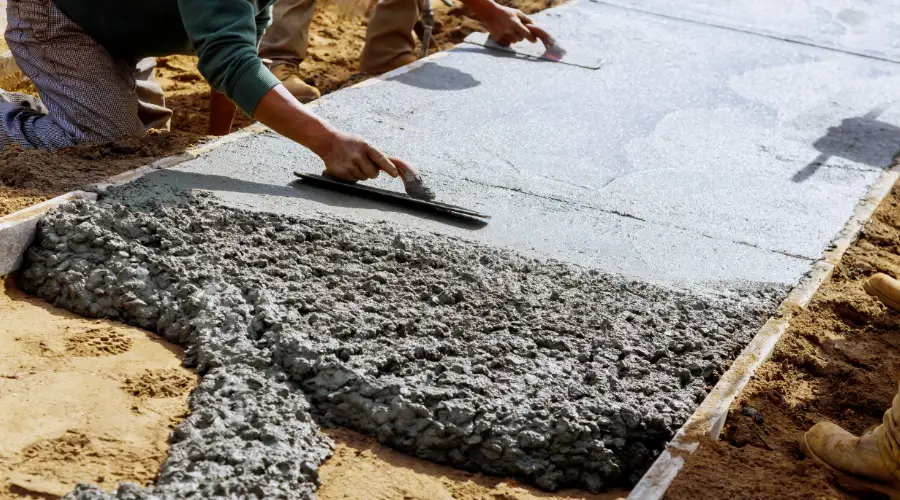
The mixing of PCC involves the following steps:
1. Batching:
Measure the amounts of cement, aggregates, and water accurately. Do it according to the desired mix ratio.
2. Dry Mixing:
Mix the dry ingredients (cement, fine sand, and coarse stones) in a concrete mixer. Space them out to create a balanced layout.
3. Wet mixing:
Wet mix is the Mix in the water slowly. Stir until the blend is the thickness you want.
4. Consistency check:
Check the mix’s flow using the slump test. Optimal consistency ensures success.
PCC Construction Process
1. Site Preparation
The area where PCC will be placed must be cleared of loose soil, roots, debris, organic matter, and standing water. The base should be compacted properly before concrete work begins.
If PCC is placed on loose or uneven ground, settlement can occur later. This may affect flooring, footing levels, or the next stage of construction.
2. Marking and Level Setting
Levels are marked as per the drawing. Proper level marking ensures that PCC thickness remains uniform and the next construction layer sits correctly.
For foundation work, centre lines, footing positions, and excavation levels should be checked before PCC is poured.
3. Batching of Materials
Batching means measuring cement, sand, aggregate, and water in the correct proportion. Volume batching is common for small residential works, while weigh batching gives better accuracy for larger projects.
IS 456 includes batching and mixing requirements under concrete production and quality control provisions.
4. Mixing of PCC
The materials should be mixed until the concrete becomes uniform in colour and consistency. Machine mixing is preferred for better quality. Hand mixing may be used only for small works, but it requires careful turning and proportion control.
Avoid adding excess water. More water may make concrete easier to place, but it can reduce strength and increase shrinkage.
5. Placing of PCC
PCC should be placed gently over the prepared base and spread evenly to the required thickness. It should not be dropped from excessive height or allowed to segregate.
For footing PCC, the concrete should fully cover the excavation base and provide a clean surface for reinforcement fixing.
6. Compaction
After placing, PCC should be compacted to remove air voids. Depending on the thickness and site condition, compaction may be done by tamping, rodding, or using suitable equipment.
Poor compaction can lead to honeycombing, weak zones, uneven surfaces, and reduced durability.
7. Levelling and Finishing
The surface is levelled using a straight edge or screed. For footing PCC, a rough but level finish is usually enough. For floor bases, the surface may need better finishing depending on the next layer.
The final surface should match the required level and slope, especially in plinth protection, pathways, or drainage-related areas.
8. Curing
Curing is essential for strength development. PCC should be kept moist after initial setting so that cement hydration continues properly.
IS 456 includes curing requirements as part of concrete production and workmanship guidance. Poor curing can cause dusting, cracks, weak surface, and reduced durability.
PCC Thickness in Construction
PCC thickness depends on the use, ground condition, load, and structural drawing.
|
Location |
Common PCC Thickness |
|
Below footing |
75 mm to 100 mm |
|
Below raft foundation |
75 mm to 150 mm |
|
Floor base |
75 mm to 100 mm |
|
Pathway or pavement |
75 mm to 150 mm |
|
Plinth protection |
75 mm to 100 mm |
|
Pipe bedding |
As per service drawing |
These are common practical ranges, not fixed rules. Always follow project drawings and site specifications.
PCC vs RCC
PCC and RCC are both cement concrete, but their purpose is different.
|
Factor |
PCC |
RCC |
|
Full form |
Plain Cement Concrete |
Reinforced Cement Concrete |
|
Reinforcement |
No steel reinforcement |
Contains steel bars or mesh |
|
Tensile strength |
Low |
Higher due to steel reinforcement |
|
Main use |
Base, levelling, flooring, bedding |
Beams, columns, slabs, footings |
|
Structural role |
Limited |
Major load-bearing structural work |
|
Cost |
Lower than RCC |
Higher due to steel and detailing |
|
Design need |
Simple works may use nominal mix |
Requires structural design |
PCC is suitable where reinforcement is not needed. RCC is used where the member must resist bending, tension, shear, and structural loads.
Benefits of PCC in Construction
PCC improves construction quality in several ways.
|
Benefit |
Why It Matters |
|
Provides level base |
Helps accurate footing and floor construction |
|
Prevents soil contact |
Protects reinforcement and structural concrete |
|
Improves workability on site |
Creates a clean working platform |
|
Distributes load slightly |
Supports uniform base preparation |
|
Reduces contamination |
Prevents mud and loose soil from mixing with concrete |
|
Improves durability |
Helps create a stable layer below structural work |
|
Cost-effective |
Uses simple materials for non-reinforced work |
In foundation work, PCC is especially valuable because it helps workers place reinforcement correctly and maintain concrete cover.
Common Mistakes in PCC Work
Avoid these mistakes during PCC construction:
- Pouring PCC on loose or uncompacted soil
- Using incorrect cement-sand-aggregate ratio
- Adding too much water to the mix
- Using dirty sand, muddy aggregate, or contaminated water
- Not maintaining required thickness
- Poor compaction after placing
- Skipping curing after PCC work
- Starting reinforcement work before PCC gains enough strength
- Ignoring slope in plinth protection or pavement PCC
- Using PCC where RCC is structurally required
These mistakes can lead to weak concrete, uneven levels, settlement, cracks, and poor foundation quality.
Quality Checks Before and During PCC Work
|
Stage |
Quality Check |
|
Before PCC |
Check excavation depth, base compaction, and levels |
|
Material check |
Use clean cement, sand, aggregate, and water |
|
Batching |
Maintain correct mix ratio |
|
Mixing |
Ensure uniform concrete consistency |
|
Placing |
Spread evenly without segregation |
|
Thickness |
Confirm required depth at multiple points |
|
Compaction |
Remove voids and air pockets |
|
Surface level |
Check line, level, and slope |
|
Curing |
Keep PCC moist after setting |
|
Final inspection |
Check cracks, weak surface, and uneven areas |
A simple PCC checklist helps prevent errors before the next stage of construction begins.
Practical Example: PCC Below Footing
Suppose excavation for an isolated footing is complete. If reinforcement is placed directly over soil, the bars may touch mud, lose cover, and become difficult to align. Soil may also mix with structural footing concrete.
By placing a 75 mm to 100 mm PCC layer first, the footing gets a clean, level, and firm base. The reinforcement can then be fixed properly with cover blocks, and the structural concrete can be poured with better quality control.
Advantages of Using PCC in Construction
- PCC is generally more affordable than RCC (Reinforced Cement Concrete) So, it’s good for basic structures.
- PCC is easy to apply. Its simple mixing and placement do not require specialized skills.
- Low maintenance requires minimal maintenance compared to other types of concrete.
- It provides decent thermal insulation properties, contributing to energy efficiency in buildings.
Disadvantages of Using PCC in Construction
- PCC crumbles under tension, failing as a standalone material for load-bearing structures. Its weakness demands reinforcement to withstand stress. Without added support, PCC proves inadequate for critical structural applications.
- Cracks may develop in poorly designed mixes. Certain conditions increase vulnerability, making careful formulation crucial to preventing fracturing.
- Load Capacity Constraints: Compared to reinforced concrete, this material falters under heavy burdens. Its structural limitations prevent its use in high-stress scenarios.
- Lacking reinforcement, PCC crumbles under shear and bending forces, necessitating additional support in structural applications.
How PCC Works: Dos and Don’ts
Dos:
- Ensure you use the correct mix ratio to achieve the desired strength and durability.
- Maintain proper curing to achieve optimal strength and prevent cracks.
- Regularly test materials and mixes to ensure consistency and compliance with construction standards.
- Handle and transport the concrete with care to prevent segregation and contamination.
Don’ts:
- Avoid over-watering the mix., as this can weaken the integrity and cause segregation.
- Don’t use contaminated materials. Impurities in aggregates or water can affect the quality of the concrete.
- Avoid rapid setting. Ensure there is adequate time for setting and curing to prevent issues such as cracking.
- Don’t neglect cleanliness. Equipment and tools should be clean. This avoids contamination and ensures proper mixing.
Conclusion
Plain Cement Concrete (PCC) is fundamental in construction. It is known for its simplicity and low cost. It provides a strong base for many structural elements. It also keeps out moisture. But, it is not good for high-stress applications because it lacks tensile strength. Knowing the materials used in PCC and the right mixing procedures is crucial for achieving optimal performance. Also, knowing the key differences between PCC and RCC can help in making informed decisions for construction projects. Proper handling, quality control, and best practices are vital. They ensure PCC’s performance and longevity in construction.
FAQs
- What is PCC in construction?
PCC in construction means Plain Cement Concrete, a mix of cement, sand, coarse aggregate, and water without steel reinforcement. It is mainly used for levelling, base preparation, flooring, bedding, and non-reinforced concrete works. - What is the full form of PCC?
The full form of PCC is Plain Cement Concrete. It is called plain concrete because it does not contain reinforcement bars or steel mesh like RCC. - What is the common PCC ratio?
Common PCC ratios include 1:4:8, 1:3:6, and 1:2:4, depending on use and specification. The ratio represents cement, sand, and coarse aggregate. The final mix should follow the drawing or engineer’s instruction. - Why is PCC used below footing?
PCC is used below footing to provide a clean, level, and firm base. It prevents reinforcement from touching soil, helps maintain cover, and reduces contamination of structural concrete during footing work. - What is the difference between PCC and RCC?
PCC is concrete without steel reinforcement, while RCC contains steel bars or mesh. PCC is used for base and levelling work, while RCC is used for structural members such as beams, slabs, columns, and footings. - What is the thickness of PCC below the footing?
The common PCC thickness below footing is often 75 mm to 100 mm, but the exact thickness depends on the structural drawing, soil condition, and project specification. It should not be decided by guesswork. - Is curing required for PCC?
Yes, curing is required for PCC because concrete needs moisture to develop strength properly. Poor curing can cause cracks, dusting, weak surface, and reduced durability. - Can PCC be used as structural concrete?
PCC should not be used as structural concrete where bending, tension, or major load-bearing action is required. RCC or designed concrete members should be used for structural elements as per engineering design.
 Sowjanya Siddanoor