


Pile foundation helps transfer the structure’s weight to stronger soil layers. and is a type of deep foundation. Large construction projects like bridges and buildings use pile foundations. Pile foundations are essential as they provide a strong and stable foundation. They play a critical role in the construction industry and are specially used for buildings that need to withstand extreme forces. They are mostly applicable to structures built on unstable soil. Read on to learn more about this crucial type of foundation.
What is Pile Foundation?
A pile foundation is a type of deep foundation, where long and thin structural long items like cylinders which are generally made of steel or concrete are pushed into the ground, through methods like skin friction, or end bearing, or combining both. These piles eventually help in moving the weight of the building to stable and deeper soil layers.
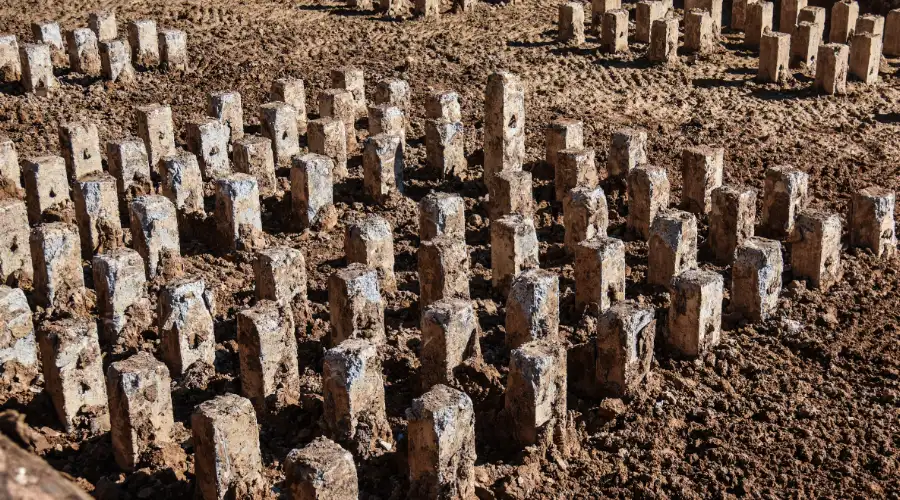
A pile foundation comes under the types of deep foundation that uses thin pillars under the ground for stability. It is typically long and made up of steel or concrete. It provides support for transferring weight to deeper layers of soil. Pile foundations are also used for high-rise buildings where the entire weight is concentrated in one precise area.
Types of Pile Foundation
The list of types of pile foundation based on function and material are mentioned below:
Types based on function:
- End-bearing piles
- Load bearing piles
- Friction piles
- Sheet piles
- Screw piles
Types based on material:
- Steel pile foundation
- Concrete pile foundation
- Timber pile foundation
- Composite pile foundation
Pile Foundation Types Based on Function
The list of types of pile foundation based on function are mentioned below
End-bearing Piles
End-bearing foundations are otherwise known as point-bearing piles. They are used in areas where a hard and strong layer is available at a reasonable depth. It is applicable in soil conditions of various kinds, including compressible soil.
The end-bearing type is better than the frictional pile. One example of an end-bearing piles is the steel H pile. It is designed to handle variations in soil conditions and high driving stresses. However, H-piles, under hard ground conditions, can bend.
Load-bearing Piles
Load-bearing pile is a type of deep pile foundation that is the most commonly used. It is applicable in the construction of tall buildings and bridges.
The piles are driven or installed into the ground to reach the bottom. A load-bearing pile foundation transfers the loads vertically. A shift happens from the weak upper layers to the stronger bottom layers. It provides stability and support where the piles can be connected through grade beams. It can distribute heavy loads evenly and provide structural support to the building. Load bearing helps control settlement in the soft soil. It is suitable in seismic areas.
Frictional Piles
Frictional pile foundation uses skin friction to transfer the load between the surrounding soil and the pile surface. It is also called a floating pile foundation. The load is distributed along the entire length of the pile through a frictional force. It necessitates careful inspection of the soil via pile interaction.
A frictional pile foundation design is used in high-rise buildings. It is usually made of a material such as concrete, timber, or steel. When there is an excessive soil settlement, a friction-piling foundation is used. The main advantage is its tapered shape.
Sheet Piles
The sheet piling process involves interlocking sheets placed under the ground, forming. a continuous barrier. The interlocking sheets are usually made of plastic, wood or steel. It is placed using a hammer, hydraulic press, or any vibratory equipment.
Types of Sheet Pile Foundation
- Z type
- Flat type
- Pan type
When compared to cold rolls, hot role piles have a tighter interlock. This is suitable for hard driving conditions. It is mainly used for sea walls, bulk retaining walls, etc., where it acts as a barrier to the underground water flow.
This foundation type is inexpensive and can be installed easily, leaving less environmental impact. Reducing soil displacement provides high stability and strength to the structure. Often they are used in groups to support large buildings.
Screw Piles
Screw piling, also known as helical piling, involves installing long steel piles shaped like screws under the ground.
Screw pile foundation designs are applicable in various projects, including:
- Buildings and townhouse developments
- Commercial and industrial like office buildings, factories, and shopping centers
- Development of infrastructure such as bridges, boardwalks, and retaining walls.
- They are also used as equipment foundations in mining and resources such as conveyor systems.
Pile Foundation Types Based on Material
The following are respective types and pile foundation details based on materials used:
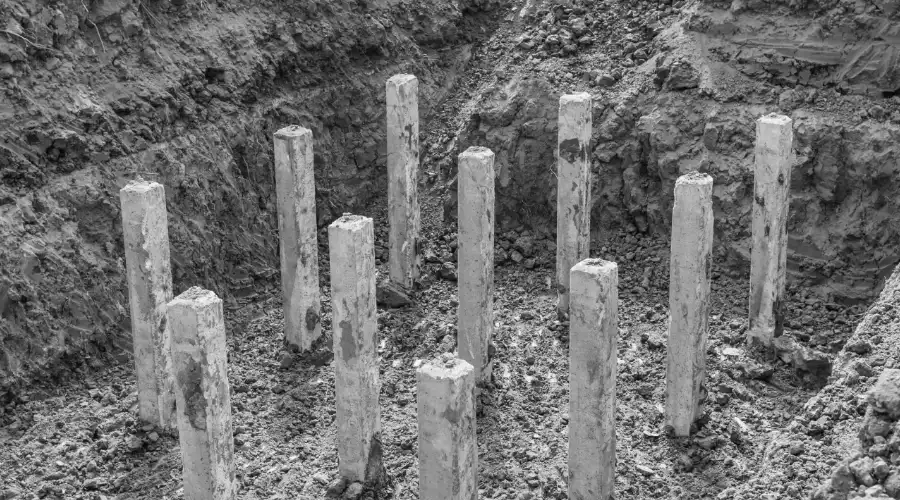
Steel Pile Foundation
Steel piles are often cylindrical or H-shaped and can be driven into the ground or drilled and filled with concrete.
Types of Steel Piles
- H-Piles
- Pipe Piles
- Screw Piles (Helical Piles)
- Disc Steel Piles
Steel pile foundations have several advantages, including:
- Steel piles are much stronger than the soils they are driven into. Therefore, it can resist very high loads, bringing greater stability.
- It is simple and cost-effective to adjust the length of a steel tube or H-pile on the job site. Steel piles are easily adaptable.
- The customer knows the quality of all the components that will be driven into the ground before installation.
However, they must be adequately treated before placement to ensure resistance to corrosion.
Concrete Pile Foundations
Concrete pile foundations are generally used for heavy buildings that cover a smaller area, including water tanks, skyscrapers and, large bridges,. They are efficient, cost-effective, and environmentally sustainable. On average, they can last for about 30 to 100 years.
Types of concrete pile foundations:
- Precast concrete piles
- Cast in situ piles
- Prestressed concrete piles
The concrete pile foundation uses a cylindrical or square column.
Factors such as soil condition, load requirement, and environmental factors influence the design of the concrete pile foundations. They are highly durable and resistant to environmental factors.
Advantages
- It has a high load-bearing capacity
- They are highly suitable for different types of soil.
- A concrete pile foundation can also be used in areas of high water ground levels.
Timber Pile Foundation
In this type, treated wood piles are driven into the ground in wet or unstable soil conditions. Timber piles are often square or round in shape. The diameter range is between 12 and 16 inches, and the length is usually 20 times the width of the top. It is capable of transferring a 20-ton load. The strength is increased using a fish plate that can be fixed to the sides.
Types of timber pile foundation
- Untreated timber piles, which are used in temporary structures
- Treated timber piles are chemically treated to resist decay and insects.
The timber pile foundations are easy to handle and install. They are also known to be cost-effective and environmentally friendly.
Compared to concrete pile foundations or steel piles, the timber pile foundation has a limited lifespan.
The timber pile foundation helps minimize the settlement of the structure. It is predominantly used in areas prone to scouring, such as near riverbeds.
Composite Pile Foundation
A composite pile foundation combines two or more different materials. It includes concrete, steel, or timber to optimize the load bearing capacity and increase the performance.
Types of composite pile foundations:
- Concrete-steel composite pile
- Timber-concrete composite pile
- Steel concrete composite pile
Advantages of using composite pile foundation:
- Increased load capacity
- Improved structural performance
- Provides flexibility in design efficiency.
- It combines the strength of different materials.
- Increased durability and resistance to corrosion
- Highly suitable in seismic areas where the conditions of the soil are unpredictable.
When is a Pile Foundation Necessary?
The following points explain when to use pile foundation in construction projects.
1. Weak or Compressible Surface Soils
When there is a need to build a structure above a site where the topsoil has a weak bearing capacity and cannot safely support the weight of the planned structure. For example, the structure above soft clay, loose silt, or filled ground. With this foundation, the pile transfers loads to deeper, stronger soil or rock layers.
2. Heavy Structural Loads
Projects like high-rise buildings, bridges, or industrial complexes often generate very high vertical and lateral loads. Where shallow foundations are not sufficient, piles ensure that these loads are safely carried to competent strata at depth.
3. High Water Table or Sites Near Water
If the construction site is near water bodies (for example, rivers, lakes, or coastal zones), or has a high water table that makes deep excavation impractical, pile foundations are necessary to prevent problems such as water seepage and uplift.
4. Areas Prone to Uplift or Lateral Forces
Pile foundations are chosen where there is a need to resist significant uplift (tension), lateral loads (wind, seismic activity), or overturning forces. For example, in earthquake-prone areas or for bridge abutments.
5. Sites at Risk of Settlement, Erosion, or Scouring
On sites where soil may settle unevenly (differential settlement), erode, or scour (such as riverbeds and reclaimed land), pile foundations anchor the structure safely below the depth affected by such changes, minimizing future risk.
Advantages of Pile Foundation
- Pile foundations help transfer the building loads to a more stable soil found below several layers. It provides stability in sites that have weak upper layers of soil.
- Pile foundations are resistant to weathering, decay, and corrosion. Therefore, they are highly durable.
- It requires less space when compared to other foundation types, due to slender and long foundation elements.
- It can be customized based on the project requirements and can be constructed in different sizes and materials.
- They are effectively used in areas where deep installations are required, especially wetlands. Pile foundations help in preventing uplift in structures.
- It minimizes vibrations and also prevents soil erosion around the foundation.
- Pile foundations are cost-effective and can be quickly installed. It helps speed up the construction process.
- It has less environmental impact compared to other foundations.
Pile Foundation Cost: What to Expect
In India, pile foundation costs vary mainly by material (concrete, steel, timber) and installation technique. Typical rates for cast-in-situ concrete piles range from ₹2,500–₹4,000 per running meter for standard residential and low-rise buildings, while precast and steel piles can cost ₹4,000–₹6,000 per running meter or more for specialized uses. Site conditions, required depth, and pile diameter significantly affect the total cost. Factors such as soil testing, equipment mobilization, and local labour rates also influence the final amount.
Pile foundation forms the base to support large buildings in unstable soil conditions. It plays a vital role in constructing projects in situations where the top layer of the soil is weak. The pile foundation type is needed to follow proper design, testing, installation, and maintenance. To build that effectively for your residential or commercial project hire an expert construction firm. With their help you can build pile foundations that transfer load into deep layers of soil and contribute to high safety and security, enhancing the longevity of the building and its infrastructure.
FAQs on Pile Foundation
The limit of foundation piles depends on various factors including the soil conditions, load requirements, and design specifications. Typically, the number of piles required is determined based on:
Load-Bearing Capacity: The size and number of piles must support the structural loads of the building.
Soil Properties: Soil strength and load-bearing capacity influence the type and number of piles.
Design and Code Requirements: Engineering standards and local building codes specify pile design and spacing.
An RCC pile foundation is a type of deep foundation where piles are made from Reinforced Cement Concrete (RCC). These piles are used to transfer the load of a structure to deeper, more stable soil layers or rock. RCC piles are reinforced with steel bars to enhance their strength and load-bearing capacity. They are typically used in situations where surface soil conditions are inadequate for supporting structures, such as in areas with weak or compressible soil.
The minimum depth of a pile foundation generally starts at 5 to 10 meters (approximately 16 to 33 feet), but this can vary based on factors such as soil conditions, load requirements, and local building codes. The actual depth is determined by a geotechnical engineer, who assesses the soil profile and structural loads to ensure the pile foundation reaches a stable layer capable of supporting the building’s load effectively.
Pile foundations can be expensive, but the overall cost depends on different factors.
 prasanthkumar
  wordpress-prod