


Propping in construction refers to the support structures that are used only temporarily to stabilize and secure building elements while the construction or remodeling work is in progress. By far the most common of these are center pole bracing, posts (with screw jacks), and needles, which are required in both the least complex and the most complex cases.
The amount and kind of prop that will be needed depend on various factors such as the load’s weight, the project’s complexity, and the support duration. In this post, we will discuss the types, uses, and importance of propping in construction.
What is Propping in Construction?
Propping in construction refers to a temporary support provided to any structure that is being built, repaired, or altered. The propping ensures the safety of the workers and the reliability of the building because of the additional support to elements like floors, ceilings, walls, and beams that are not fully supported or are being modified.
Propping systems consist of props, shores, and scaffolding that are specifically designed to carry the exact loads that the project requires. The correct use of propping is a preventive measure for structural failure, which minimizes the chance of accidents, and it is indeed necessary for safeguarding construction safety and stability during the process.
Importance of Propping in Construction
Undoubtedly, propping performs a critical function in keeping incomplete, newly repaired, or renovated structures safe, steady, and intact. These are the reasons why it is,
- Protection
One of the primary functions of propping is to furnish much-needed temporary support to the building elements that have been weakened or left without alternates at the time of construction. This lowers the likelihood of the structure’s collapse and diminishes the chances of a heavy machine accident on the construction site.
- Load Distribution
Propping distributes the live load and forces evenly throughout the structure, thereby preventing the phenomenon of local overloads, which could lead to material breakdown.
- Structural Stability
Temporary props are used to maintain the position of the beams, floors, walls, and ceilings during the installation or replacement of permanent supports. When the building phase is completed, the props are removed.
- Compliance and Regulatory Requirements
By stressing regulatory compliance, a propping system is employed in order to drastically reduce the risk of death and severe injuries of workers, thus being compliant with rules and building codes, which are essential for safe and effective work in the industry.
Application of Propping Systems
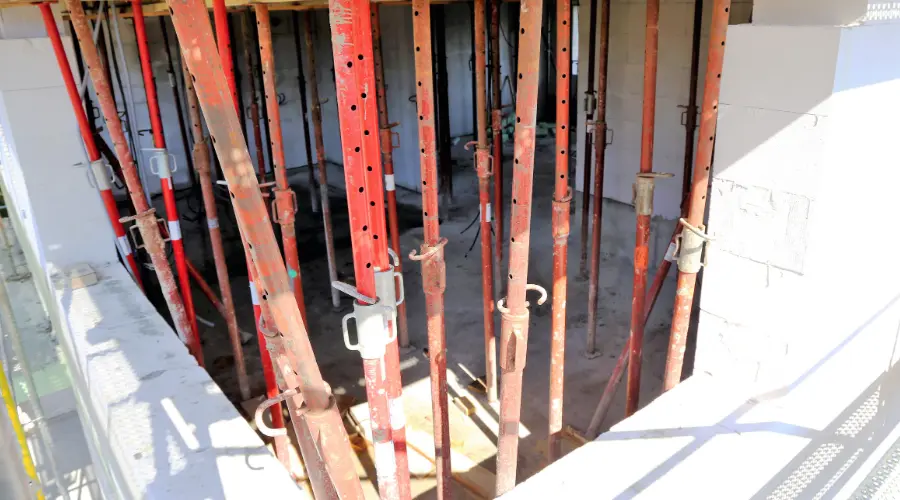
Propping systems are frequently employed in various construction projects to ensure temporary support and that the structures are safe and stable during different phases of the work. Several key applications are,
- Formwork Support
Propping is a must to sustain formwork (i.e., molds used to give concrete a specific shape) while the concrete is being cast and is set. It acts as a pillar to support the wet concrete till that stage when it solidifies and gets its strength.
- Structural Changes
In the process of carrying out renovations or structural modifications, propping systems are used to temporarily support beams, columns, or floors when the original supports are removed or replaced.
- Bridge and Tunnel Construction
During the construction of a bridge or the excavation of a tunnel, the propping systems are utilized for various purposes, including making sure that the necessary safety of sections of the structure or the excavation walls is achieved during both the building and repairing processes.
- Floor Slab Support
The propping is needed under a floor slab to bear the weight while the concrete is being laid, ensuring that the slab will be leveled and stable as the initial formwork is removed and additional layers of concrete are poured.
- Scaffolding Support
While scaffolding is primarily used for worker access, propping systems are sometimes integrated to support working platforms or stabilize scaffolding structures, especially in high-rise construction or where cantilevered scaffolding requires additional support.
Various Propping Systems
The following are various kinds of propping systems, all of which have a specific purpose in their design.
1. Titan Props
The type of adjustable props that are strong enough to bear large loads in the construction business. As a traditional material for such props, high-quality steel provides strong stability and durability; it is ideal for heavy-duty work such as formwork or slab support during the pouring of concrete.
2. Acrow Props
It is a multiple-purpose type of adjustable prop that is commonly utilized for aiding structures like walls, beams, and slabs. They are built with a telescopic system which makes the height adjustment process easy and faster. In the industry of scaffolding and shoring, the item provides a good solution to the design as well as the flexed thing.
3. Steel Props
A popular choice of material as they are thick, strong, and can carry heavy loads. Such props, made from steel tubes, are used to hold together different parts of the construction process, especially when casting, shoring, and temporary systems are involved in the process.
4. Needle Beam Support
In cases where the load needs to be spread over a large area, needle beams are the ones that are used. The propping system as such, consists of the horizontal beam that is laid on top along the vertical props and has often been used as a powerful tool to support the walls when a building is being dismantled or under renovation.
5. Timber Props
Made of resilient timber, is usually used in not-so-demanding environments, where a solid foundation is not a must. They are a reliable and inexpensive means of temporary support.
6. Shoring Props
These are the things that are usually used for temporary support, such as when digging or repairing buildings. They can be varied in size and are normally used on the concrete base or in underground tunnel construction, so they are very useful tools for propping up the structures there.
7. Scaffolding Props
Scaffolding props are used to maintain the balance of the scaffold during construction. They help the scaffold carry a load of workers, equipment, and instruments, resulting in high safety levels at precarious heights.
All of these propping systems are of great importance in the stability, safety, and efficiency of construction across various applications.
Methods of Propping in Construction
Several important methods are given below,
1. Load Distribution
Proper load distribution is crucial in propping systems. If the load is not evenly distributed among all the props, it can lead to instability and potential failure of the structure. When pressure is applied, each prop must bear an equal or appropriately calculated share of the load. This prevents overloading of any single prop and ensures the entire system remains balanced and structurally safe.
2. Vertical Propping
Supports are placed under the floor, ceiling, wall, etc., at a perpendicular angle to the ground. Generally, this method is used to replace dead loads and facilitate the efficient management of gravity forces.
3. Horizontal Propping
Horizontal propping supports the elements subjected to lateral forces (i.e., forces acting along the surface of the structure). By horizontal propping, those components that require resistance against lateral movement, maximum stability can be achieved. Often, this method is employed in conjunction with vertical propping to provide support from all directions.
4. Combination Propping
In the combination propping, both vertical and horizontal support systems are put into use, leading to stability in multiple directions. This innovative and impressive technique is perfect for complicated and unstable structures, and especially so if multiple forces are acting; it will be the best way of being fully protected from the forces.
Factors to Consider When Choosing Propping Systems
- Load Requirements
Estimate the weight of the structure or materials being supported. The propping system that should be capable of carrying the correct load without any problem should be the one chosen to solve the task, whether temporary or permanent support is required.
- Type of Construction
It is the structure’s nature (e.g., a bridge, a building, or a roof) that determines the most suitable propping system. Some of the systems are designed to support such specific cases as formwork shoring and so on.
- Height and Span
It is essential to consider the height and span of the structure. Taller or wider spans require propping solutions that are more stable and that have a greater load-carrying capacity, such as steel beams or reinforced concrete columns.
- Site Conditions
One should analyze the ground conditions, specifically the soil stability and the access for the workers. Remember that not only the equipment but also the space for its installation are decisive elements that one should take into account before setting up the formwork or shoring system.
- Duration of Support
The time during which the props will be in use largely depends on the material to be selected. In case of prolonged support, the use of strong, more heavy-duty systems will likely be the option.
One of the first steps in any construction project is selecting a propping system that is safe and will ensure success.
Design Considerations for Propping
When creating a propping system in construction, a number of important considerations are kept in mind so as to offer the best safety and economy.
- Load-Bearing Capacity
The system must be designed to withstand the combined weight of both dead loads (permanent loads) and live loads (temporary loads, such as workers, equipment, or materials). Incorrect assumptions could lead to an overload situation.
- Material Selection
The use of the right materials, like steel, timber, or aluminum would ensure the strength, longevity, and specific requirements can be met.
- Height and Span
The height and the distance between the supports will indicate the size and the number of props to be used. Longer spans may require the use of sturdy materials like steel beams or reinforced columns.
- Site Conditions
It is necessary to determine the type of propping system to be installed and its location, taking into account information about ground stability, location convenience, and environmental conditions. (e.g., weather) That may affect the usage of props.
Conclusion
Formworks are of great value in the field of building as they play a major role in ensuring that the buildings are strong and secure through the whole phase of construction, as well as during repairs or renovations.
Moreover, there are some factors that a professional propping expert has to consider while designing a propping structure, such as load-bearing capacity, material characteristics, site features, and height and span requirements.
Furthermore, a secure system that is properly constructed is not only the key to the safety of the people working in the area but also makes it easy for the construction process.
 Sowjanya Siddanoor