

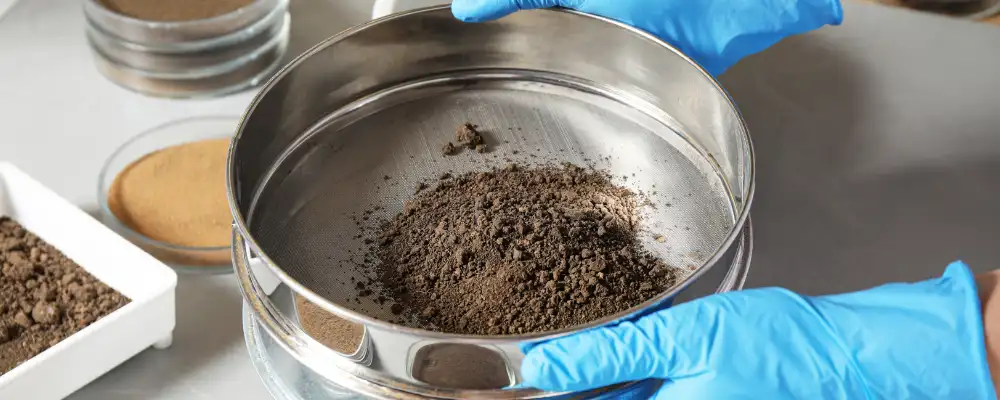
Sieve analysis of fine aggregate is a laboratory test used to determine the particle-size distribution of sand or other fine aggregate. The test helps establish whether the material has an appropriate grading for its intended construction application. By passing a representative sample through a series of standard sieves and measuring the material retained on each sieve, engineers can calculate percentages retained, cumulative percentages, and fineness modulus. These results help assess aggregate consistency and support concrete and mortar mix proportioning. This guide explains the purpose, procedure, calculations, interpretation, and practical importance of fine aggregate sieve analysis.
Quick Answer
Sieve analysis of fine aggregate determines how sand particles are distributed across different sizes. A dry aggregate sample is passed through a stack of sieves, the retained material is weighed, and the percentage retained and passing are calculated. The results can be used to assess grading and calculate fineness modulus, subject to the applicable testing standard and project requirements.
Overview of Sieve Analysis of Fine Aggregates
Sieve analysis is a common laboratory method. This helps in determining the gradation or particle size distribution of fine aggregates. In a sieve analysis, the material is passed through a series of sieves with varying mesh sizes, enabling the separation and classification of particles according to their size. Fine aggregate is a granular material of size less than 4.75 mm.
Sieve analysis helps determine whether a material is fine or coarse. This is crucial for meeting performance expectations in terms of construction usability. Sieve analysis is a simple, widely used technique applied to both organic and inorganic materials, as well as to granular materials such as sand, crushed rock, soil, and powders. The results of a sieve analysis enable you to assess the suitability of fine aggregates for concrete and mortar mixes, making it a critical process in material testing and quality control within civil engineering.
Purpose of Sieve Analysis of Fine Aggregate
- Aids in the determination of the fineness modulus, which is the average particle size of a fine aggregate sample.
- Provides a representation of the grain size distribution, illustrating the distribution of particles through various sizes of sieves.
- Determines the general grading of aggregates to indicate if the material is either fine or coarse aggregate.
- It plays a crucial role in determining the viability of fine aggregates for construction purposes, particularly in concrete mixtures.
- Gives a good picture of the uniformity or variability of particle size in a batch of fine aggregate.
- It makes the grading of material into four zones possible, which is crucial for the specification of the right aggregate type for certain construction requirements.
- It helps in the identification of changes in the material source, as any change in fitness modulus indicates a change in aggregate origin.
- It supports quality control and construction consistency by tracking changes in aggregate properties over time.
- Affects the workability and appearance of concrete, so this test is critical to mix design and performance prediction.
- Provides a consistent means to guarantee the fine aggregate complies with project specs and construction requirements.
Sieve Analysis of Fine Aggregate According to IS Code
Sieve analysis is one of the standard laboratory tests that measure the particle size distribution of fine aggregates. The test, according to IS specifications and MORTH guidelines, classifies sand into various grading zones in order to ascertain its appropriateness for concrete construction.
Test Apparatus Required
The following equipment and instruments are required to perform sieve analysis of fine aggregates:
- IS Sieves: Available sizes are 10 mm, 4.75 mm, 2.36 mm, 1.18 mm, 600 microns, 300 microns, and 150 microns. A lid and a pan are also needed.
- Oven: To dry the fine aggregate sample.
- Weighing Balance: To 0.01 g accuracy in order to measure retained weights accurately.
- Tray: To carry and hold the material.
- Brush: Used to brush and transfer material caught on sieves.
- Mechanical Sieve Shaker: To uniformly and effectively sieve for repeatable results.
Sieve Analysis Process for Fine Aggregate
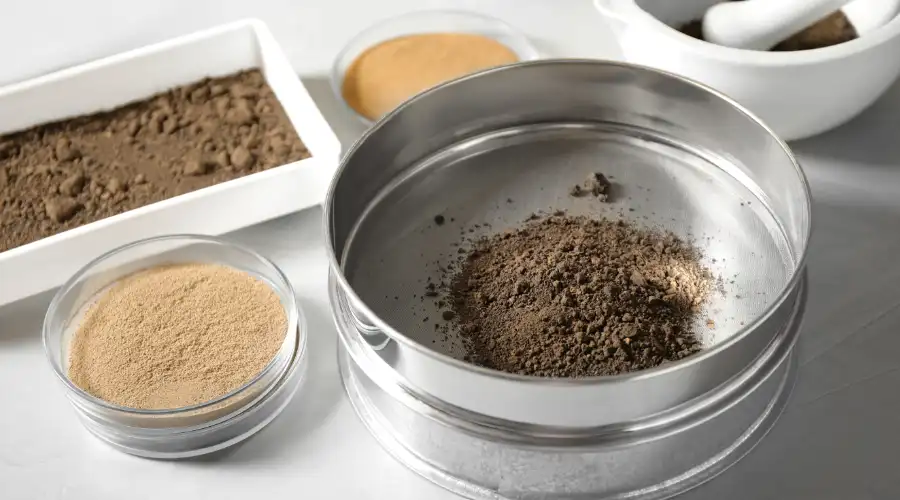
The procedure to carry out the sieve analysis is organised and has to be executed step by step:
Sample Selection
- Take a 1 kg representative sample from a 10 kg lot by quartering the lot to attain uniformity.
- Ensure the sample is dry and free from lumps before testing to allow for accurate separation during sieving.
Sieve Arrangement
- Place the sieves in sequence, beginning with the top 10 mm sieve, followed by 4.75 mm, 2.36 mm, 1.18 mm, 600 microns, 300 microns, and 150 microns sieves.
- Position a pan at the base to catch the finest particles passing through the smallest sieve.
- All sieves should be clean and stacked tightly and evenly aligned to avoid material leakage during shaking.
Sample Loading
- Add the 1 kg sample to the top sieve and close the lid to prevent material loss during agitation.
Mechanical Sieving
- Securely fit the sieve stack in the mechanical sieve shaker.
- Operate the shaker for a minimum of 10 minutes to fully separate the particles.
Mass Measurement
- Once sieving is done, remove each sieve carefully and brush retained particles to ensure none remain stuck in mesh openings.
- Weigh and document the mass of material retained on each sieve using the precision balance.
- Clean each sieve with a brush before weighing it to collect all particles accurately.
Calculations and Analysis
- Calculate the percentage retained on each sieve by taking the retained weight and dividing it by the sample total weight, then multiplying by 100.
Percentage Retained = (Weight Retained on Sieve/Total Sample Weight)×100
- Calculate the cumulative percentage retained and the cumulative percentage passing for plotting purposes.
- Plot the graduation curve to determine the type of graduation.
Requirement for Grading of Fine Aggregate
Fine aggregate to be utilised in concrete should be within one of the four grading zones specified in the IS standards. I.e., Zone I, II, III, and IV. The classification is done on the basis of the percentage retained or passed through a standard set of sieves.
According to IS 383
- Grading of fine aggregate is categorised into four zones (I to IV) based on sieve size distribution.
- If grading falls outside of the limits for any sieve other than 600 micrometres by up to 5%, and the total deviation across sieves does not exceed 10%, the aggregate can still be considered within that zone. This tolerance does not apply to the 600-micrometre sieve, nor to sieves at the coarse limit of Zone I or the fine limit of Zone IV.
- For crushed stone sand, the percentage passing the 150 micrometre sieve may increase up to 20%, without affecting the general 5% tolerance.
The Bottom Line
Sieve analysis of fine aggregate is an important quality control process in construction that facilitates the evaluation of particle size distribution and grading of aggregates into suitable grading zones. The test ensures the fine aggregate conforms to IS standards and is acceptable for use in concrete production.
Precision in sieve analysis enhances mix design, workability, and long-term structure performance. Continuous testing also assists in identifying changes in material sources. This leads to consistent construction quality and project reliability.
Final Thoughts
Sieve analysis of fine aggregate provides a practical way to understand the particle-size distribution of sand used in construction. By measuring material retained on each sieve, calculating cumulative percentages, and assessing the grading and fineness modulus, engineers can evaluate aggregate consistency and suitability for intended applications. The test is most useful when the sample is representative and the procedure follows the applicable standard. For concrete and mortar work, grading should be considered alongside other material properties, mix requirements, and quality-control results rather than used as the only measure of aggregate quality.
FAQs
- What is sieve analysis of fine aggregate?
Sieve analysis of fine aggregate is a test used to determine the distribution of sand particles by size. A known dry sample is passed through a series of sieves, and the material retained on each sieve is weighed. The results are used to calculate percentages retained, cumulative retained values, percentage passing, and other grading indicators.
- Why is sieve analysis important for sand?
Sieve analysis helps determine whether sand has a suitable particle-size distribution for its intended application. Aggregate grading can influence concrete and mortar workability, water demand, packing, finish, and material requirements. The test also helps identify variations between different aggregate sources or batches.
- What is fineness modulus of fine aggregate?
Fineness modulus is an index calculated from cumulative percentages retained on a specified series of sieves. It provides a general indication of whether an aggregate is relatively fine or coarse. A higher value generally indicates coarser material, but FM does not fully describe the complete particle-size distribution.
- What is the formula for percentage retained in sieve analysis?
The formula is: Percentage retained = (Mass retained on the sieve ÷ Total dry sample mass) × 100. After calculating the percentage retained for each sieve, the cumulative percentage retained can be determined by adding the values from the larger sieves through the sieve being considered.
- What is percentage passing in sieve analysis?
Percentage passing represents the proportion of the original sample that passes through a particular sieve. It can generally be calculated as 100 − cumulative percentage retained for that sieve. The resulting values can be plotted against sieve size to create a particle-size distribution or grading curve.
- Which standards are used for fine aggregate sieve analysis in India?
Fine aggregate testing and grading are addressed by applicable Indian Standards, including IS 2386 (Part 1) for methods of test for aggregates relating to particle size and IS 383 for coarse and fine aggregate specifications. Always use the current applicable edition and project requirements when performing or interpreting the test.
- Does a higher fineness modulus mean finer sand?
No. A higher fineness modulus generally indicates a relatively coarser aggregate, while a lower value indicates a relatively finer aggregate. However, fineness modulus is only a summary index. The complete sieve analysis should be reviewed because different particle-size distributions can produce similar FM values.
- How does aggregate grading affect concrete?
Aggregate grading can affect workability, packing, water demand, cement paste requirements, segregation, and surface finish. A suitable grading can support efficient particle packing and consistent concrete production. The appropriate grading depends on the concrete requirements, aggregate characteristics, applicable standards, and overall mix design.
 Sowjanya Siddanoor