


How to get Patta Chitta Adangal is a common question for landowners and buyers in Tamil Nadu because these records help verify ownership, land type, survey details, and village-level land information. Patta shows ownership details, Chitta records land classification such as wet or dry land, and Adangal gives additional village revenue record details. These documents are often checked during property purchase, land verification, construction planning, and ownership updates. This guide explains the meaning, required documents, online method, offline method, fees, verification steps, common mistakes, and buyer precautions. Brick & Bolt explains that Patta, Chitta, and Adangal serve separate purposes in Tamil Nadu land records.
Quick Summary
To get Patta Chitta Adangal, visit the Tamil Nadu eServices land portal, choose the relevant land record option, enter district, taluk, village, patta number or survey number, complete authentication, and download the record. You can also apply offline through the VAO or Taluk office with identity, address, ownership proof, and application details.
If you have ever bought land in Tamil Nadu, you must have heard these three words: Patta, Chitta, and Adangal. These three words are names of documents that serve a separate purpose in maintaining land records.
- A Patta proves your ownership of the property.
- A Chitta contains details about the property (size, area, etc.)
- An Adangal is an extract from the village record that contains more details about the property.
All three documents are necessary to buy a property in Tamil Nadu. This article will look at how to buy these three documents online and offline.
What is Patta Chitta?
Patta is a government document that shows who owns a piece of land in Tamil Nadu. It has details like the owner’s name, the land’s size, and what the land is used for (e.g., farming, housing).
Chitta is another document that tells whether the land is wet or dry. This is important for knowing how the land can be used and taxed.
Together, Patta and Chitta help prove land ownership and understand the land’s type and usage.
How To Get Patta Chitta Adangal
There are two ways you can obtain the adangal , patta and chitta documents:
- Online method
- Offline method
Before that, Let’ see Is there any application fees for getting documents or There any documents required for verification purpose.
Application Fees and Required Documents
Application Fees:
- Usually, there is a small fee for processing requests for patta, chitta, and adangal documents. The exact amount may vary based on the state or local authorities. You should check the official government website. Or, contact the local tahsildar office for exact details.
Required Documents:
- Proof of Identity: Aadhaar Card, Voter ID, Passport, or any other government-issued ID.
- Proof of Address: Aadhaar card, ration card, utility bills, and so on.
- Proof of Ownership: Sale Deed, Tax Receipts, or any document proving ownership of the land.
- Application Form: The form must be filled out. You can get it from the government office or download it online.
Let’s look into a step-by-step process of getting these documents through both methods.
Online Method
- Visit The E-Services Portal
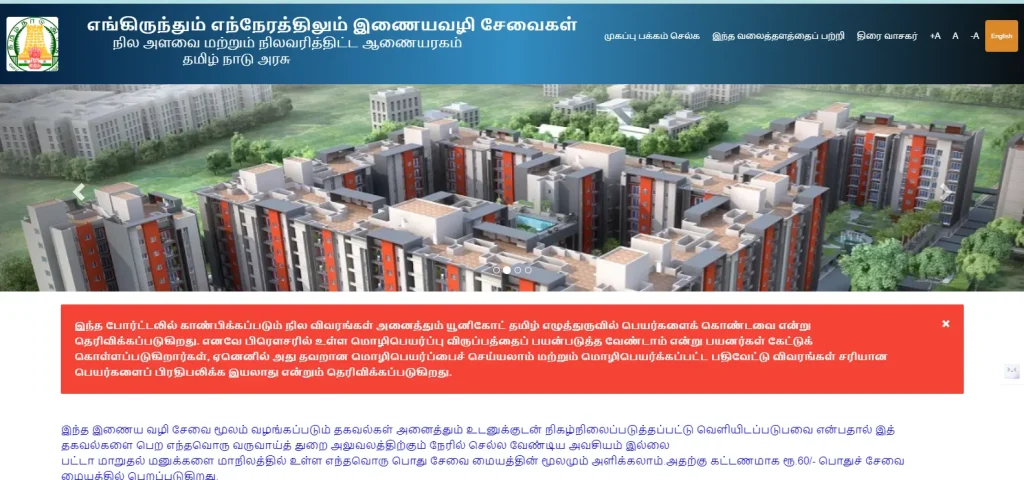
The first step is to visit the official Tamil Nadu e-service website . All the land records of the state will be present in this website.
- Navigate To Land Records
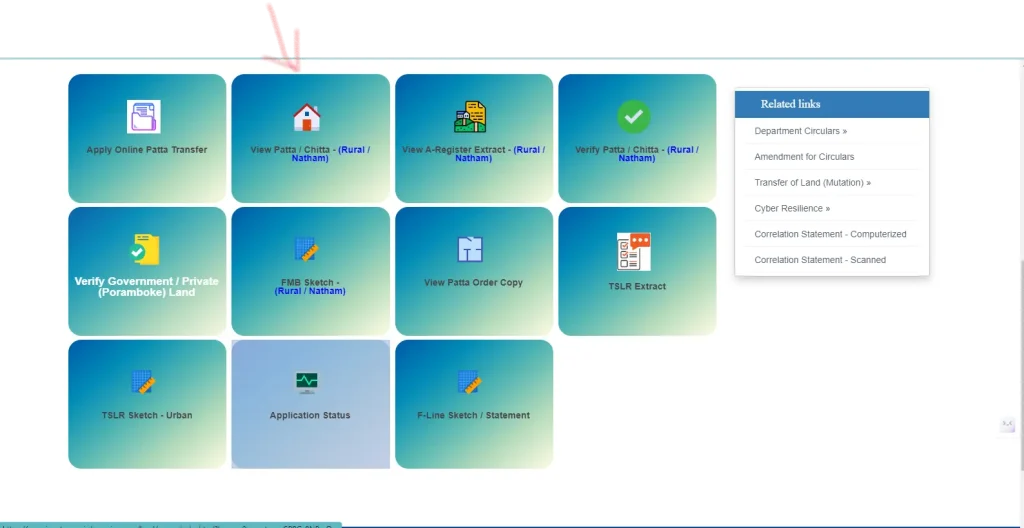
Go to land records. There, you will find many options for land records, like “Apply online patta transfer,” “View patta/chitta – (Rural/Natham),” “View A-Register Extract – (Rural/Natham),” “Verify patta/chitta,” etc.
In that, select “View patta/chitta – (Rural/Natham)” to view your Patt or Chitta and select “View A-Register Extract – (Rural/Natham)” to view your Adangal.
- Select Your District
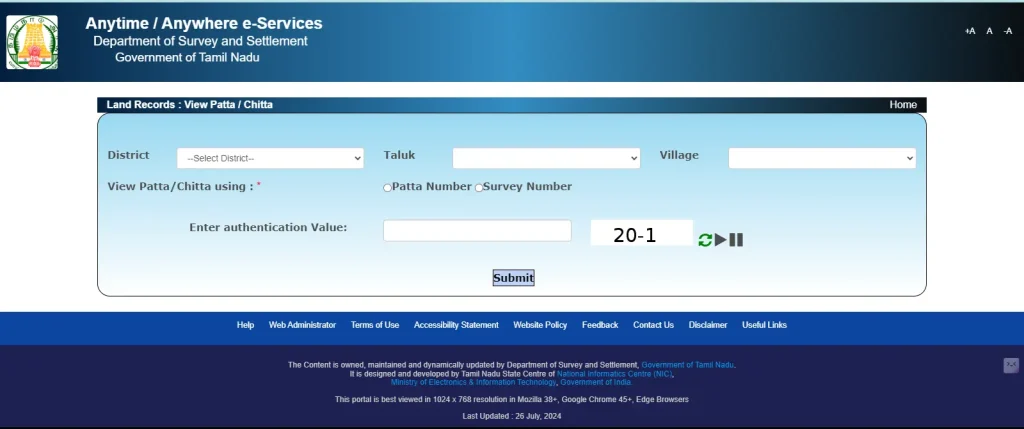
Enter details of your land like District, Taluk, and Village. You will also have to enter your patta number or survey number. Click “Search” after entering the authentication value given in the form.
You can find your survey number in your property documents.
- Download Your Document
You will then be taken to the document page. You can view the document and download it if you wish to for future reference.
The online method is simple: You only need the location details of your property and the patta or survey number to download your documents in minutes.
Offline Method
- Visit Your Local Village Administration Office
Visit the local Village Administrative Office (VAO) or Taluk office in your area.
- Inquire About Patta Chitta Adangal
Consult the designated personnel and collect all details about the procedure involved in getting patta, chitta, and adangal documents from the office. Understand clearly what documents and details you need to provide.
- Provide Property Details
Submit your application form along with the required documents. Clearly explain the purpose of obtaining the document and whether you require a patta, chitta, or adangal extract. If you need all the documents, mention them clearly.
- Pay Applicable Fees
You will be charged a nominal fee to collect the documents. It may vary from district to district. So enquire how much you need to pay and pay the fees along with your documents and application letter.
- Collect Your Document
You might be given a processing time required to receive the document. You will be notified once the document is ready, and you can get them from the office.
Conclusion
Knowing how to get Patta Chitta Adangal helps landowners and buyers verify Tamil Nadu land records with more confidence. The online method is useful for quickly viewing Patta/Chitta, A-Register, TSLR, and related records, while the offline method through the VAO or Taluk office is better for corrections, missing details, and official support. These documents help confirm ownership, survey details, land extent, classification, and village-level records. However, they should be checked along with sale deed, EC, FMB, tax receipts, approvals, and legal opinion before buying, selling, or building on land.
Getting your patta, chitta, and adangal documents is an easy process that involves very few steps. Also you can Change Your Name in Adangal even after Documentation is done. It is best to get the documents online instead of going to the office. It can save you time and can get you the documents very quickly.
FAQs
- What is Patta Chitta Adangal?
Patta Chitta Adangal refers to Tamil Nadu land records used to check ownership, land details, classification, and village revenue information. Patta shows ownership details, Chitta records land type such as wet or dry land, and Adangal provides additional village-level land information. - How to get Patta Chitta Adangal online?
You can get Patta Chitta Adangal online through the Tamil Nadu eServices land portal by selecting the relevant land record option, entering district, taluk, village, patta number or survey number, completing authentication, and viewing or downloading the document. - How to get Patta Chitta Adangal offline?
You can get Patta Chitta Adangal offline by visiting the Village Administrative Office or Taluk office, asking for the required process, submitting the application with identity, address, and ownership proof, paying applicable fees, and collecting the document after processing. - What documents are required for Patta Chitta Adangal?
Common documents include Aadhaar card, voter ID, passport, address proof, sale deed, tax receipts, ownership proof, survey number, subdivision number, and application form. The exact requirement may vary based on record type, location, correction request, or transfer purpose. - What is the difference between Patta and Chitta?
Patta mainly records ownership details of a land parcel, while Chitta records land classification and related property details such as whether land is wet or dry. Together, they help verify land ownership and land type in Tamil Nadu revenue records. - What is Adangal used for?
Adangal is used to check village-level land details such as owner information, survey number, land classification, extent, crops, irrigation sources, trees, wells, tenancy, and liabilities. It is especially useful for agricultural land and revenue record verification. - Is there a fee for getting Patta Chitta Adangal?
Yes, a nominal fee may apply in some cases, especially for offline requests or official processing. Brick & Bolt notes that exact fees may vary by local authority, so applicants should check the official portal or local tahsildar office for current charges. - Can Patta Chitta Adangal prove complete property ownership?
No, Patta Chitta Adangal should not be treated as the only proof of complete property ownership. It should be checked along with sale deed, parent documents, encumbrance certificate, FMB sketch, tax receipts, land-use records, approvals, and legal opinion before any transaction.
 Sowjanya Siddanoor
  wordpress-prod