


Coarse grained soil is soil made mainly of visible sand and gravel particles, usually with more than half of its mass in larger grains. It is widely used in construction because it drains well, compacts effectively, has low compressibility, and can provide good load-bearing support when properly placed. Brick & Bolt explains that coarse-grained soil contains grains from 0.075 mm to 60 mm and includes sand and gravel fractions. This guide explains its meaning, types, properties, construction uses, comparison with fine-grained soil, testing needs, limitations, and site precautions.
Quick Summary
Coarse grained soil is mainly sand and gravel with particles large enough to be seen by the naked eye. It is useful in foundations, road bases, embankments, drainage layers, railway ballast, retaining wall backfill, and trench filling. Its main strengths are high permeability, low compressibility, good shear strength, and better moisture stability than clay-rich soils.
In this blog, we will explore everything about coarse-grained soil, types of soil, what it is and why it is important, and where it does all the work.
What is Coarse-Grained Soil?
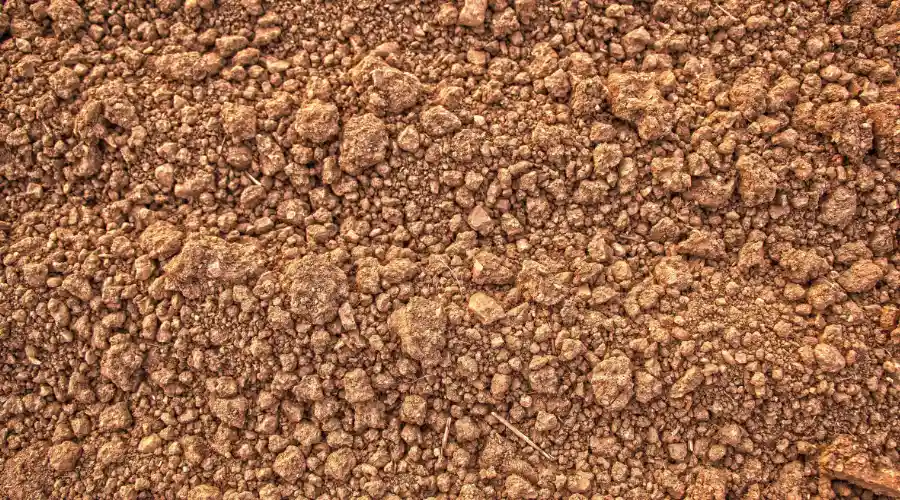
Coarse-grained soil refers to the soil that has grains between 0.075 mm (75 microns) and 60 mm, accounting for more than 50% of its total mass. It has gravel fill (particles ranging from 4.75 mm to 60 mm) and sand (particles ranging from 0.075 mm to 4.75 mm). Due to its relatively large particle size and low fines content, coarse-grained soil exhibits high permeability, low compressibility, and low cohesion. When properly compacted, it shows excellent engineering properties such as high shear strength, good drainage, and stability, so that it is often used as a filling material in embankments and highway construction.
Importance of Coarse-Grained Soil in Construction
Coarse-grained soils are considered essential for construction works because of their strength, stability, and drainage ability. These soils, hardly affected by moisture changes, have been regarded as the most reliable bases in road and railway construction. With coarse-grained sands located around a structure, water holding capacity will decrease, hydrostatic pressure will decrease, and there will be fewer chances of damage.
Characteristics of Coarse-Grained Soil
High Permeability
Being coarse-grained, these soils have large particles and very wide void spaces. This structure allows water to flow through them very easily; hence, they have a very high permeability. They can have a hydraulic conductivity ranging from 10⁻⁴ up to 10¹ cm/s and can be used as drainage layers and filter placements wherever speedy removal of water is of concern.
Low Cohesion
The soils do not show any cohesion or very little due to their large size, thus not allowing any electrochemical inter-particle attraction, unlike clays. Therefore, the strength depends mainly on inter-particle friction rather than cohesive bonding. Nonetheless, the frictional resistance increases with particle angularity and compaction.
Good Load-Bearing Capacity
When compacted properly, such soils can bear heavy loads with high bearing capacity of soil. On the contrary, the high shear strength and low compressibility of these soils make them the best choice for foundations, retaining walls, and embankments. Their capacity to maintain structural properties when bearing loads makes coarse soils popular in geotechnical engineering.
Relatively Non-Plastic
Coarse-grained soils are non-plastic. This means that under an imposed stress, coarse soils do not undergo any permanent deformation. They have no Atterberg limits and do not change their behavior with moisture content, unlike fine-grained soils such as clays. Coarse soils, therefore, tend to be more stable and predictable for engineering applications.
Properties of Coarse-Grained Soil
Shear Strength
Coarse-grained soils possess very high shear strength, primarily due to interparticle friction. Their strength parameters are dependent on particle size, angularity, density, and confining pressure. Angle of internal friction (ϕ) usually varies between 30° and 45°, being higher for well-compacted gravels. They are thus suitable for load-bearing uses, such as foundations and slopes.
Compressibility
Coarse-grained soils remain largely non-compressible under normal loading conditions. Most of the settlement occurs immediately after loading due to the rearrangement of particles, whereas clayey soils settle over time through consolidation. This property ensures the long-term stability of a structure either built on or composed of these soils.
Density
Depending on compaction and gradation, the dry density of coarse-grained soils usually ranges between 1.6 and 2.2 g/cm³. High-grade ones tend to yield higher densities and better performance enhancement. Density enables good load-bearing quality and resistance to deformation.
Drainage Capacity
Because of the large voids and open structure of coarse soils, they provide very good drainage. They are used for road pavement on layers, around foundations, and for filter systems. Good drainage helps reduce the damage caused by water, such as frost heaving and surface erosion.
Frost Resistance
Generally, soils resist frost action more when clean and well-drained, as they cannot hold water to expand or contract during freeze-thaw cycles. Hence, they are suitable for zones where frost heave is a concern.
Stability with Change in Moisture
Coarse-grained soils are those which undergo strength change with fluctuations in moisture content. Their strength is mostly due to mechanical interlocking and not bonds formed due to the presence of moisture. Hence, such soils are good for use in situations like embankments and flood zones where water content can vary.
Applications of Coarse Grained Soil in Construction Projects
- Embankments of Highways and Roads: Structural stability and quick drainage.
- Railway Ballast: The foundation layer for railway tracks is coarse gravel due to its bearing and drainage.
- Drainage Layers: For building drainage systems, road drainage systems, and retaining wall drainage.
- Backfilling: Used for trench filling or pits and behind retaining walls.
- Foundations: Shallow foundations where soil bearing capacity has to be considered.
Key Differences of Coarse-Grained Soil vs Fine-Grained Soil
| Coarse-Grained Soil | Fine-Grained Soil |
| Identified based on the particle size or grain size. | Identified based on its plasticity. |
| Individual particles are visible to the naked eye. | Individual particles are not visible to the naked eye. |
| Classified into sand and gravel.Gravel: > 4.75 mm; Sand: 4.75 mm to 75 microns. | Classified into silt and clay.Silt: 75 to 2 microns; Clay: < 2 microns. |
| Grain shapes vary from rounded to angular. | Silt particles are spherical, and clay particles are flaky. |
| 50% or less material passes through the No. 200 sieve. | 50% or more material passes through the No. 200 sieve. |
| Engineering properties depend on grain size and arrangement. | Properties are influenced by mineralogy and moisture content. |
| Minimal strength change with moisture variations. | Strength varies significantly with moisture changes. |
Conclusion
Coarse grained soil is one of the most useful soil types in construction because it offers drainage, stability, low compressibility, and good load-bearing performance when compacted correctly. It includes sand and gravel, and its behaviour depends on gradation, density, particle shape, and fine content. It is widely used in foundations, embankments, roads, drainage layers, railway ballast, backfill, and sub-base work. Still, it must be tested before structural use. Proper compaction, drainage planning, erosion control, and geotechnical advice help ensure that coarse soil performs safely and reliably.
FAQs
- What is coarse grained soil?
Coarse grained soil is soil made mainly of sand and gravel-sized particles. Brick & Bolt defines it as soil with grains from 0.075 mm to 60 mm, forming more than 50% of its total mass. - What are the main types of coarse grained soil?
The main types of coarse grained soil are sand and gravel. Brick & Bolt states that gravel ranges from 4.75 mm to 60 mm, while sand ranges from 0.075 mm to 4.75 mm. - Why is coarse grained soil good for construction?
Coarse grained soil is good for construction because it has high permeability, low compressibility, good shear strength, and better stability under changing moisture conditions. These properties make it useful for foundations, roads, embankments, drainage, and backfilling. - Is coarse grained soil good for foundations?
Yes, coarse grained soil can be good for foundations when it is dense, clean, well-compacted, and has adequate bearing capacity. Brick & Bolt notes that compacted coarse soil can support heavy loads and is used in foundation-related applications. - What is the difference between coarse grained soil and fine grained soil?
Coarse grained soil contains sand and gravel and is identified mainly by particle size. Fine grained soil contains silt and clay and is identified more by plasticity, mineralogy, and moisture behaviour. Brick & Bolt also notes that coarse particles are visible to the naked eye, while fine particles usually are not. - Does coarse grained soil drain water well?
Yes, coarse grained soil usually drains water well because its larger particles create wider void spaces. Brick & Bolt explains that this high permeability makes it suitable for drainage layers, filter placements, and foundation drainage. - What are common construction uses of coarse grained soil?
Common uses include highway embankments, road bases, railway ballast, drainage layers, retaining wall backfill, trench filling, foundations, filter layers, and pavement sub-base work. These applications benefit from its drainage, stability, and load-bearing properties. - What tests are needed before using coarse grained soil?
Important tests include grain size distribution, moisture content, compaction, field density, relative density, permeability, shear strength, bearing capacity, and fines content. Testing confirms whether the soil is suitable for foundations, roads, drainage layers, or backfill.
 prasanthkumar
  wordpress-prod